

I’m delighted to collaborate with Money Machine Newsletter
A publication designed to help you become a smarter, independent investor with a two phased approach:
Market-beating stocks in a 5-min read. Picked by elite traders. Delivered weekly to your inbox pre-market.
Market, investing, and business insights from insiders and experts outside the mainstream media.
I was able to get them to provide an exclusive for my readers for which I’m grateful and will now pass them the floor:
This week’s market, investing, and business insights from insiders and experts outside the mainstream media:
Visa’s been untouchable for 60 years—that’s changing.
Betting $1.5T behind the stuff countries fight over.
$5B silent backbone of every new plane.
The most profitable restaurant in America.
And more. Let’s get to it!
Top Insights of the Week
1. 🤔 A Kill Shot for Visa?
60 years. That’s how long Visa’s been the default. Apple Pay didn’t change that. PayPal didn’t either. Why?…
Simple. Visa was never about having better technology. It was about being everywhere. Every store, every website, every checkout button. That’s the whole game.
But here’s what’s changing…
The checkout button stays the same. The plumbing underneath? Totally different. Watch what’s happening globally. China bypassed Visa for WeChat Pay. Brazil built Pix, processes ~6B transactions per month. They didn’t fight Visa. They just went around it.
Now Amazon and Meta are making their move. And they’re using stablecoins to do it. Same value as the dollar in your pocket, but they move like email instead of wire transfers. Just last week, its market cap reached a record $314B.
Amazon already owns your checkout. Meta already has your payment info. All they do is flip the backend to stablecoins. Easier said than done, but you get the point.
You click “buy.” Looks identical. Feels identical. But now the fee is ~0.3% instead of ~3%. The money settles in seconds instead of days.
Amazon won’t call it crypto. Meta won’t mention blockchain. They’ll just quietly route around Visa’s entire network. Same button, different pipes. You won’t notice. That’s the point. The only question is timing.
2. 👀 $1.5T to Become a Shadow Superpower
JPMorgan just put $1.5T on the table. Not for a new app. Not for another banking product. For something else entirely…
They’re buying into four things: minerals, defense tech, energy systems, and AI infrastructure. The stuff that actually matters when countries compete.
Banks usually follow the government’s lead. Not this time. JPMorgan’s getting ahead of it. Way ahead.
Think about it. The government moves slow. Always has. Meanwhile, other countries are locking up minerals. Hoarding chips. Building their own systems. So JPMorgan steps in. Not to help. To become necessary.
This isn’t philanthropy. It’s not patriotism either. It’s simpler than that. They’re making themselves un-fireable.
When your money runs the defense systems, powers the grid, and controls the compute — you’re not a bank anymore. You’re infrastructure. Like roads or water. Except private. Not invest in America. Become load-bearing for America. Big difference.
3. 💰 $5B Silent Backbone of Every New Plane
Hexcel (HXL) doesn’t build planes — it builds what planes are now made of. Their carbon composites now make up ~50% of modern aircraft weight (Boeing 737, Airbus A320, rockets, hypersonics).
Airbus’s A350 and Boeing’s 787 are ramping production toward 10-12 per month over the next 2-3 years. And Hexcel already has a $10B order backlog.
Why this could compound quietly?
Aviation is becoming less reliant on aluminum.
Lighter plane = cheaper fuel = non-optional.
Hexcel makes composites for hypersonics, satellites, and rockets, all seeing a surge in investment.
Market cap: $5.1B
6% of shares repurchased since 2024
P/E ratio: 58.4
52-week high: $71.05
52-week low: $45.28
The risks…
A recession or travel shock could delay the plane ramp.
Hexcel only gets paid on new aircraft builds, not maintenance.
If the ramp slips a year, the stock could stall before ripping.
Bottom line… this is a time does the heavy lifting investment. The production curve is set. Margins expand automatically once utilization hits. Become a premium subscriber and get alerted when this stock triggers our setup for entry point, target price, and stop loss.
Top 3 Charts of the Week
1. 🍱 Din Tai Fung Earns More Per Restaurant Than Any Other Chain in the US
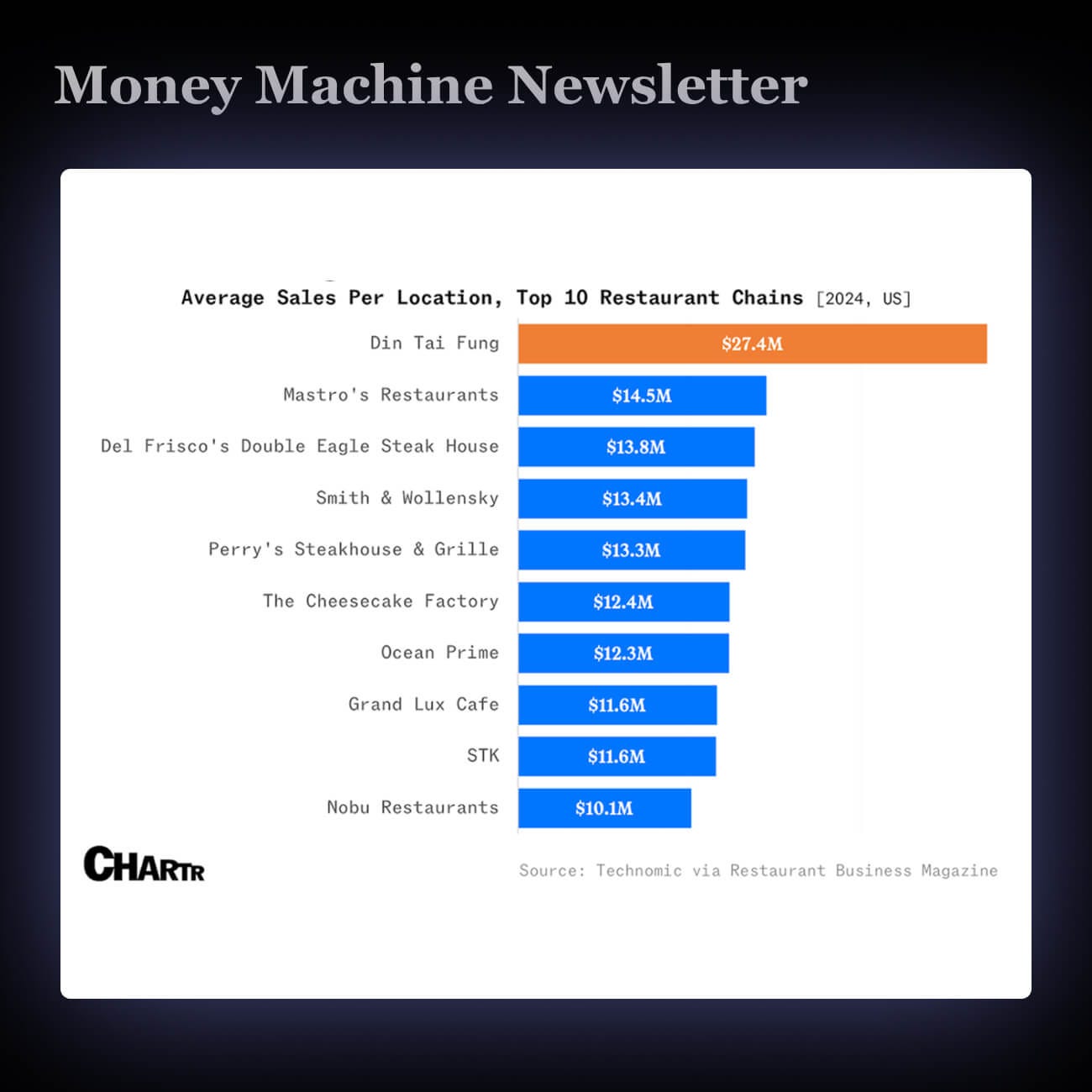
Din Tai Fung isn’t McDonald’s-sized — but each location prints money. Just 16-17 US restaurants average $27.4M per store, making it the highest-earning chain per location in America.
They cracked the formula: huge dining rooms, long lines all day, and high spend per table from shareable banquet-style orders. One Times Square location alone moves ~15M dumplings a year.
It proves scale isn’t the only path — efficiency per square foot is a superpower. DTF makes more from one store than most chains do from 50. That’s the real competitive moat.
2. 😕 Amazon Web Services Outage Takes Down Major Websites Including Reddit, Snapchat, and Venmo
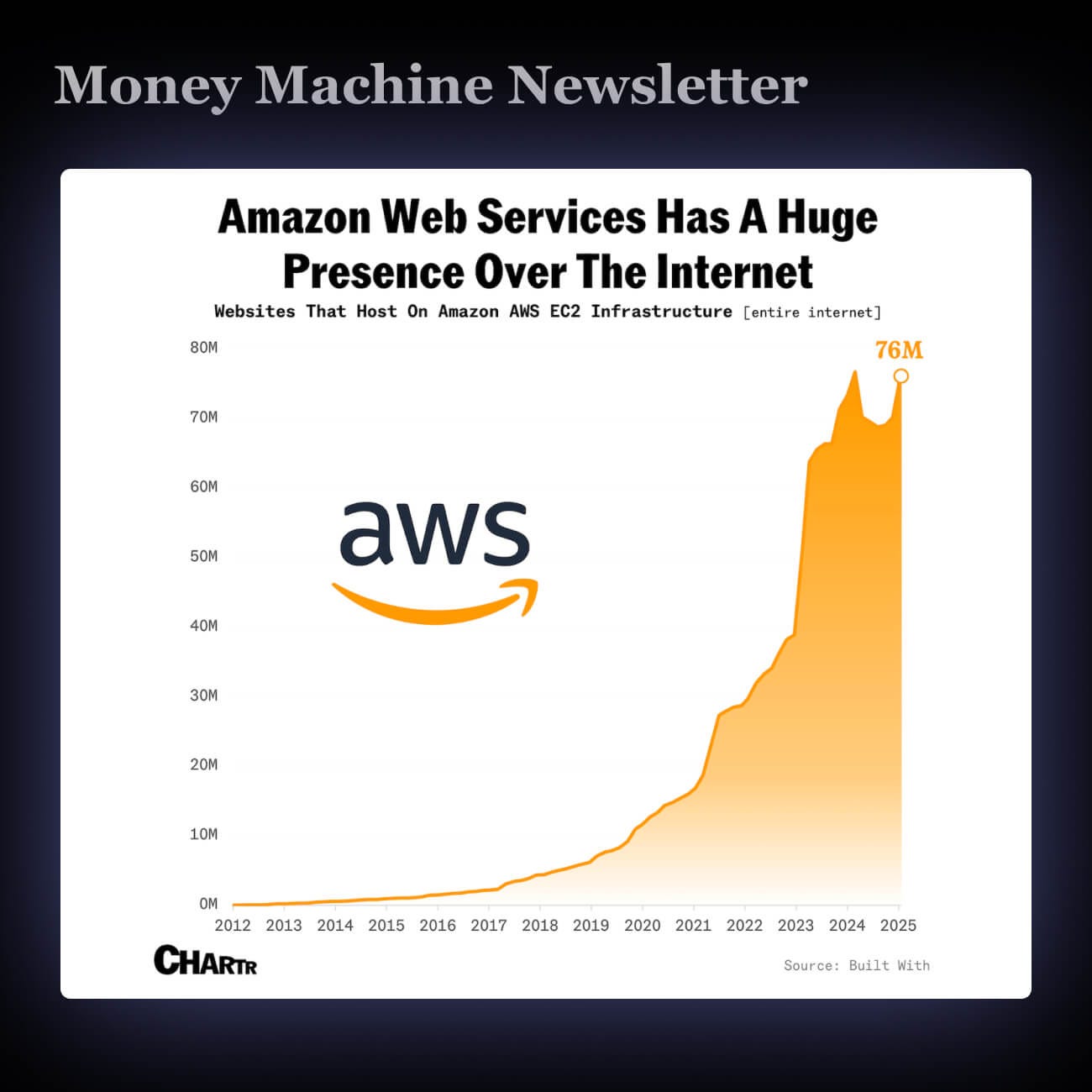
Amazon’s cloud — the backend for 76M websites — went down in Virginia and took huge apps like Snapchat, Reddit, and Venmo down with it. A DNS failure broke the internet’s address book for a few hours.
One company controls way too much of the internet’s plumbing. AWS alone powers 20,000+ sites making over $1 million/month — when it sneezes, businesses around the world stop working instantly.
Your apps, your money, maybe even flights (United went down too) depend on someone else’s server staying awake. AWS makes 53% of Amazon’s profit — and one regional glitch still slows the entire internet.
3. 💸 Kering To Sell Its Beauty Arm To L’Oréal In A $4.3B Cash Deal
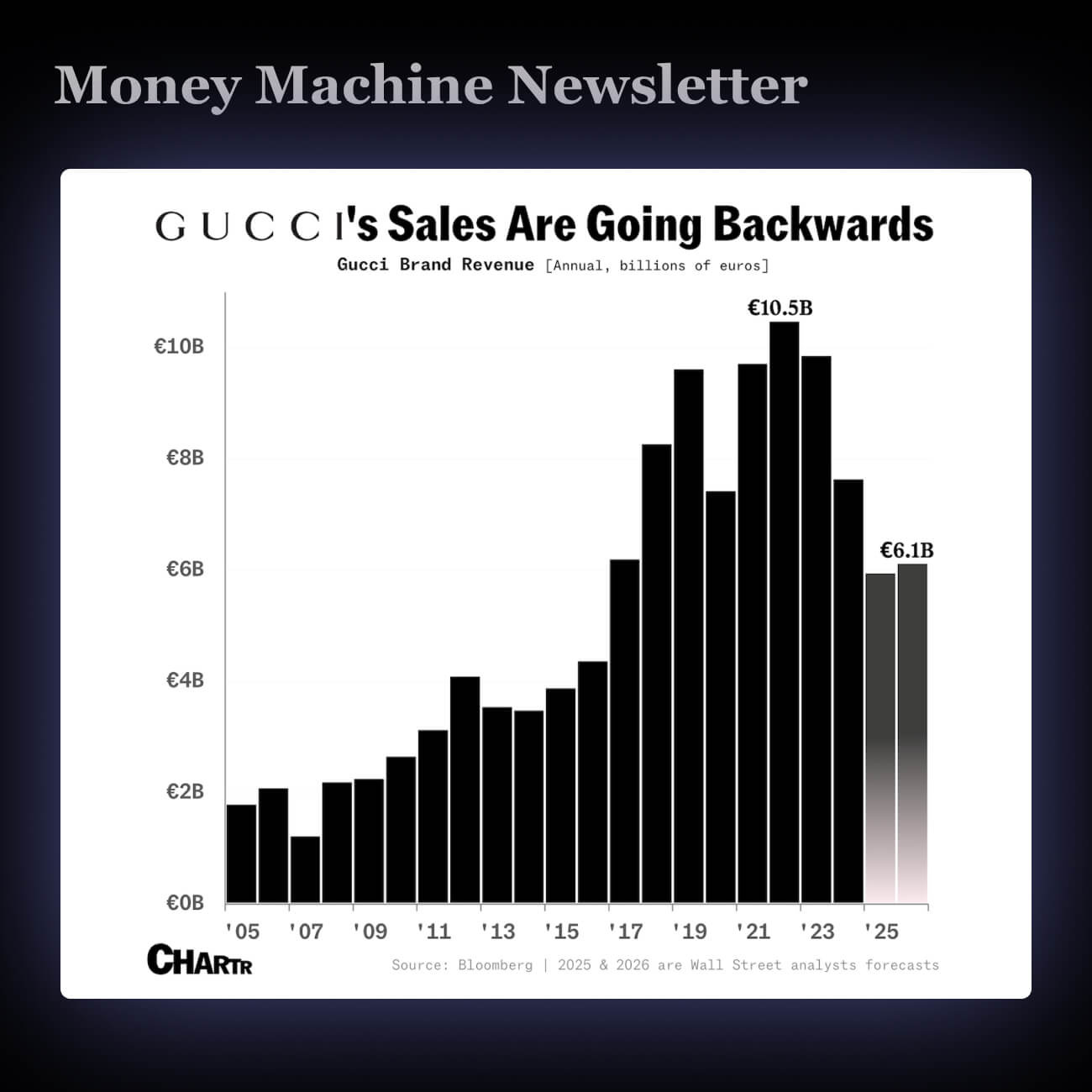
Kering is exiting the beauty business — selling its perfume and cosmetics division to L’Oréal for $4.3B in cash. That includes Creed and 50-year beauty licenses for Gucci, Balenciaga, and more.
Kering is sitting on $11.2B in debt after luxury demand slowed — and Gucci, which drives nearly half its revenue, is struggling. Flashy brands are losing steam as consumers shift toward “quiet luxury.”
L’Oréal just got even stronger in beauty. Kering is in retreat mode. If Gucci doesn’t rebound soon, this could be the start of a bigger sell-off.
Join 6,000+ self-directed investors who have already placed themselves on the path to greater wealth—potentially making $500, $1,000, $2,000, $3,000, or more every month with Money Machine Newsletter’s trade ideas.
See you in there!
Best,
Money Machine Newsletter
Disclaimer: This publication is intended solely for documenting my personal journey with trading and investments for income and travel purposes. I am not a certified financial advisor nor am I a financial professional and none of the content provided should be construed as investment advice. It is essential to conduct your own thorough research and consult a registered financial service provider for appropriate guidance. I cannot guarantee the accuracy or completeness of the information presented. Any actions taken based on the information shared in any of my work are done at your own risk and discretion. Past performance is not indicative of future results. All investing involves risk, including the potential loss of principal. There is no guarantee that any investment strategy, including those discussed here, will achieve its objectives or generate profits. You should carefully consider your investment objectives, risk tolerance, and financial situation before making any investment decisions.