

Read The Entropy Trap to discover what physics knows that economics doesn’t.
The Crown Compendia: An informal dispatch on markets, money and my musings. For those who want to go deeper, the links are at the bottom.
Market Musings
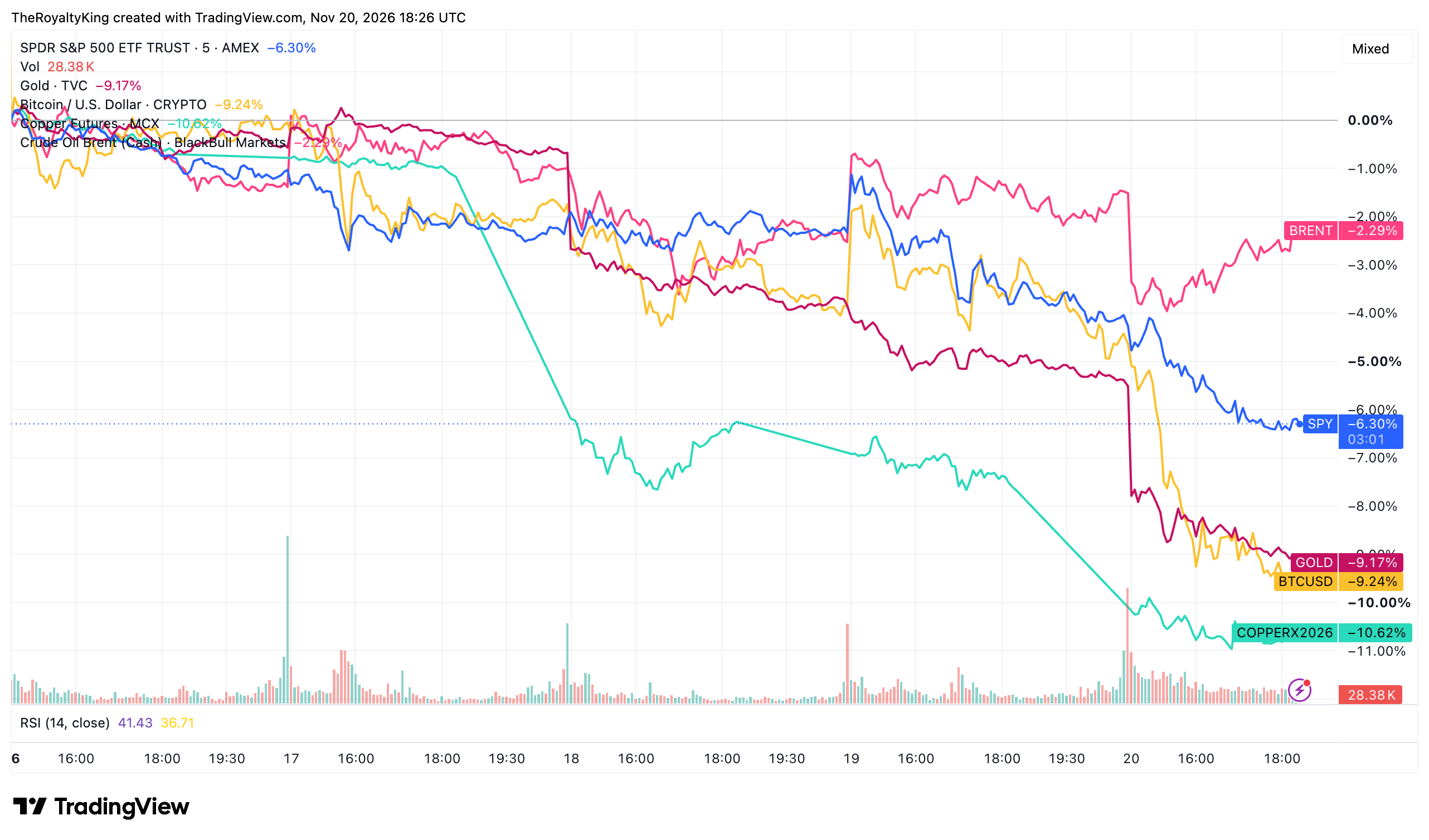
Down this week were: stocks (SP500), gold, btc, copper AND brent oil. The only major asset class to rise was the DXY (dollar index). *US gas rose 4.5% on the week but the world tends to (incorrectly) ignore gas.
Such correlation to me spells a market that’s searching for liquidity and/or perceived safety. The aforementioned hard assets are highly liquidity sensitive, with BTC being the most sensitive of the group yet it still held up slightly better than copper as per the below.
Another factor I’ve mentioned to subscribers that I’ve been wary of is Hedge fund blow ups. Anecdotally, amongst my peer group I’ve heard quite a few funds in the east blowing up so I ran a simple search to see what I could find about western funds that may have run into trouble and begun deleveraging (dumping) certain assets onto the market.
Confirmed
Walleye Capital ($17bn multi-strat): On 5 November it told investors the internal long-short equity unit would be simplified, with its leadership and many of its team members leaving and some capital going back to clients.
Industry-wide de-risking: Goldman’s prime brokerage saw gross leverage at US long-short funds drop 9 percentage points in a week, the biggest cut since March 2020. Morgan Stanley’s prime brokers called it the steepest risk reduction in more than a decade, driven by the AI stock rout after the midterms.
There remain numerous unconfirmed stories. One datapoint that I find interesting as to the precious metals trade is in September, COMEX managed-money net longs fell by 84 tonnes while gold ETFs added 67 tonnes (World Gold Council). Futures speculators sold while ETF investors kept buying.
Translation = That split is leveraged funds getting out while ETF holders kept buying.
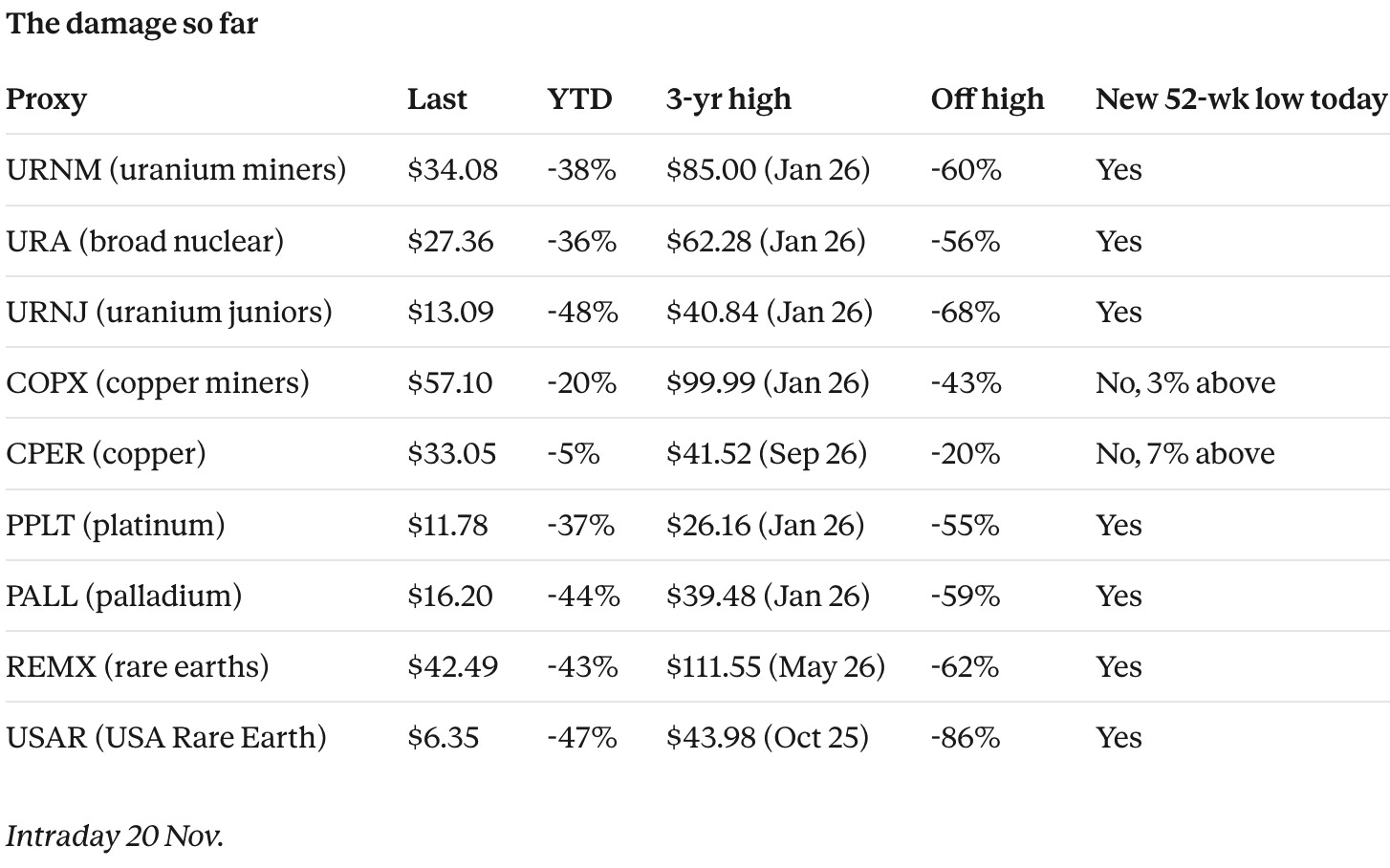
Given the shocking price action recently, a number of sectors are trading close to 52 week lows or longer. As such, I believe this is effectively a second bite-at-the-cherry providing:
I gain exposure to the theme via a sensible investment vehicle
I do not get overly-aggressive in my weightings
I allocate capital painfully slowly to reliably underwrite a reasonable entry price.
Now let’s take a look at the new sectors I’m most interested in, applying some capital cycle theory along the way. I remain invested and bullish on the previous themes I’ve written about.
Uranium, Copper, PGMs and Rare Earths
The capital cycle, pioneered at Marathon Asset Management and carried on by Hosking Partners, says to watch supply and the flow of capital, not the demand story. Starved industries produce the best returns, and flooded ones the worst.
Notes.
1. Uranium: best risk/reward - mid cycle
Supply: A decade of post-Fukushima underinvestment, and new mines take years.
Demand: This is the steadiest of the four. Reactors must be fuelled whatever the economy does, and utilities buy on long contracts. Hormuz is adding a 1970s-style energy-security pull on top. Rick Rule’s deficit maths and Erik Townsend’s technology case both still stand.
The disconnect: Spot sits near $91.55/lb and term contracts at $98, yet the miners have more than halved. Sprott puts the selloff down to liquidity pressure, not the metal. I agree.
My expression of the theme: YCA/SPUT 3-5%. URA for the broader chain including some technology names 3-5%. I’d skip any single-name junior exposure. There’s little need.
2. Copper: strongest supply case, least sold-off.
Supply: Hosking’s own copper study found the listed majors chronically short-changing the metal. It’s getting worse. Scotiabank counts planned growth spending for 2026–28 at roughly half the 2023–25 run-rate. New supply needs something like $15,000–$20,000 a tonne to get built, well above the market, so the majors are buying rivals instead of building mines.
Demand: Grids and electrification are structural, and there’s no substitute at scale. HOWEVER, copper is the most economically sensitive of the four, therefore expect weakness if economic growth stalls and or there’s a liquidity event in the roll-out of datacentres.
The disconnect: Copper dropped about 6% in a day while Shanghai was short of metal and Chinese buyers paid a record premium. That is liquidation, not collapsing demand but we are still relatively early in the anticipated roll-out of datacentres and the market is very attuned to this aspect of the copper narrative.
A comment: The miners are only 43% off their highs and still well up over three years. This was a crowded, darling trade for a while so there is likely more room to fall if the economy rolls over.
I’m buying: Indirect exposure via royalties at various stages: Altius, ELE, Evolve, FNV + IE (with hedges in the Machina Capitalis book). This is a metal I’d never buy in the physical and the miners are horrendous destroyers of capital over time. Glencore also provides some broader commodity exposure with a multi-faceted business model.
3. PGMs: earliest in the cycle, little coverage.
Supply: Hosking’s PGM research points to ten years of under-investment and deficits stretching into the 2030s. South African CEOs want $2,000–$2,500 an ounce before building. That’s double today’s price.
Demand: It’s spread across autos, jewellery, industry and hydrogen, but the long-run autocatalyst question hangs over it in the minds of the market. I think that risk is overblown and presents opportunity.
A comment: Platinum is at a 52-week low. The WPIC has 2026 in surplus before a swing back to deficit in 2027.
How I’m playing: Physical platinum and palladium 2%. Sprott’s vehicle (SPPP) is even trading at a discount to NAV currently. 2-3% allocated across: SBSW (which was a monster trade for me in the past, a 4 bagger across 12 month), Impala and Valterra. Hugo Navarro has recently published on the sector so I’ll end my note here and refer you to that piece.
4. Rare earths: starved for a decade, now flooded, but with a long lag
Supply: For years, mining and processing investment stayed clustered around China. Western capex was starved after the 2011 bust. The sector went crazy last year with the Trump admin taking stakes in certain companies.
The flood: Bloomberg Intelligence expects producers to pull in roughly $10 billion of funding in 2026. Platts analysts warn of a resultant glut in the 2030s.
The lag: Goldman reckons new mines can need up to 10 years. Fresh output shouldn’t relieve the squeeze this decade, which hands pricing power to the few producers already operating outside China. This window favours those incumbents. Developers face years of dilution first.
How to play: Basket approach. REMX and USAR 1% total. USAR has some lottery tickets hence its sizing is kept small. Keeping it simple.
My rankings
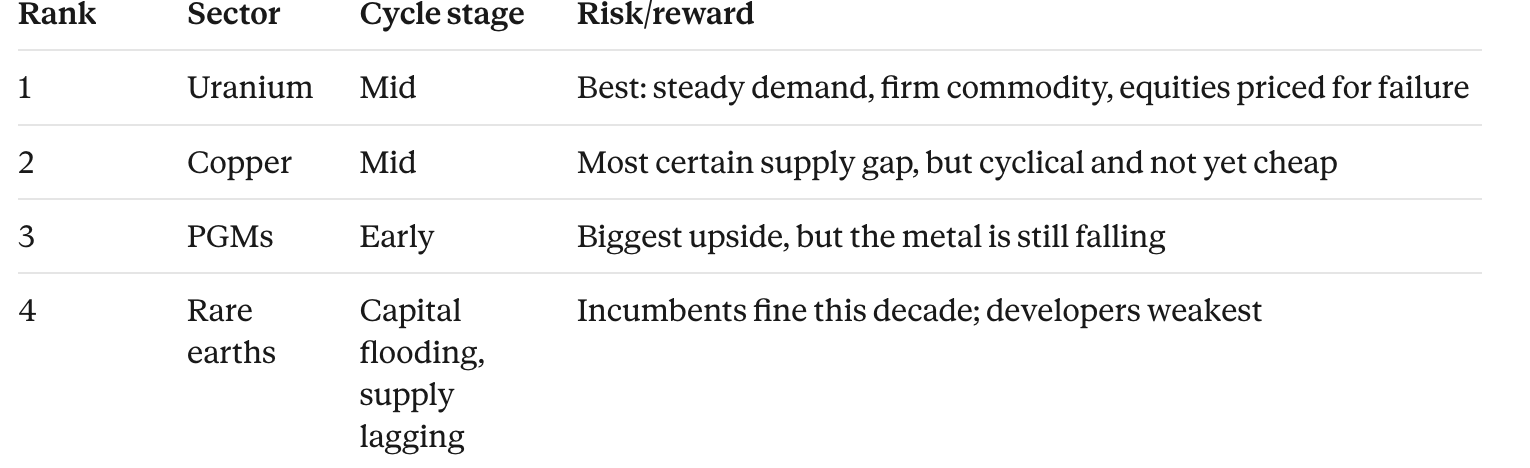
Through a mosaic of capital cycle and demand risk/reward considerations I’d rank them thusly:
Timing: Drawdowns like this are when the capital cycle pays, but nobody rings a bell at the low. This is why I’ll be scaling in slowly which I discussed in my most recent podcast with James Davolos here.
Not financial advice. Do your own work.
How I Apply A Quality Filter To Capital Cycle Investing.
The capital cycle tells me where to look. It doesn’t tell me what to buy. Miners are horrendous destroyers of capital precisely because they are the cycle: prices rise, they spend, and the returns vanish. So where I can, I own the theme through a royalty. Revenue off the top, no capex, and every mine expansion for free. Where royalties don’t exist, I keep it simple: physical metal and baskets, small and slow.
It would be remiss of me not to add that I also own the capital cycle via the exchanges and trading houses, but that’s a different series.
That royalty work is what sits behind the paywall: my research on the companies I use to own these themes, plus the subscriber chat where notes like this begin. My work has been early in identifying multi-baggers in this space and others such as covering GROY around $1, WPM in the $30s, LB in the $20s et al.
Lock in the price today before its revised in the new year.


Until next time,
All the best.
Benjamin

Disclaimer: This publication is intended solely for documenting my personal journey with trading and investments for income and travel purposes. I am not a certified financial advisor nor am I a financial professional and none of the content provided should be construed as investment advice. It is essential to conduct your own thorough research and consult a registered financial service provider for appropriate guidance. I cannot guarantee the accuracy or completeness of the information presented. Any actions taken based on the information shared in any of my work are done at your own risk and discretion.
Thanks brother!