

In Proud partnership with The Solstice Laboratory — the physics of markets, quantified. Read The Entropy Trap to discover what physics knows the economics doesn’t.
Hormuz Reignites — Hunting Cheap Energy Plays
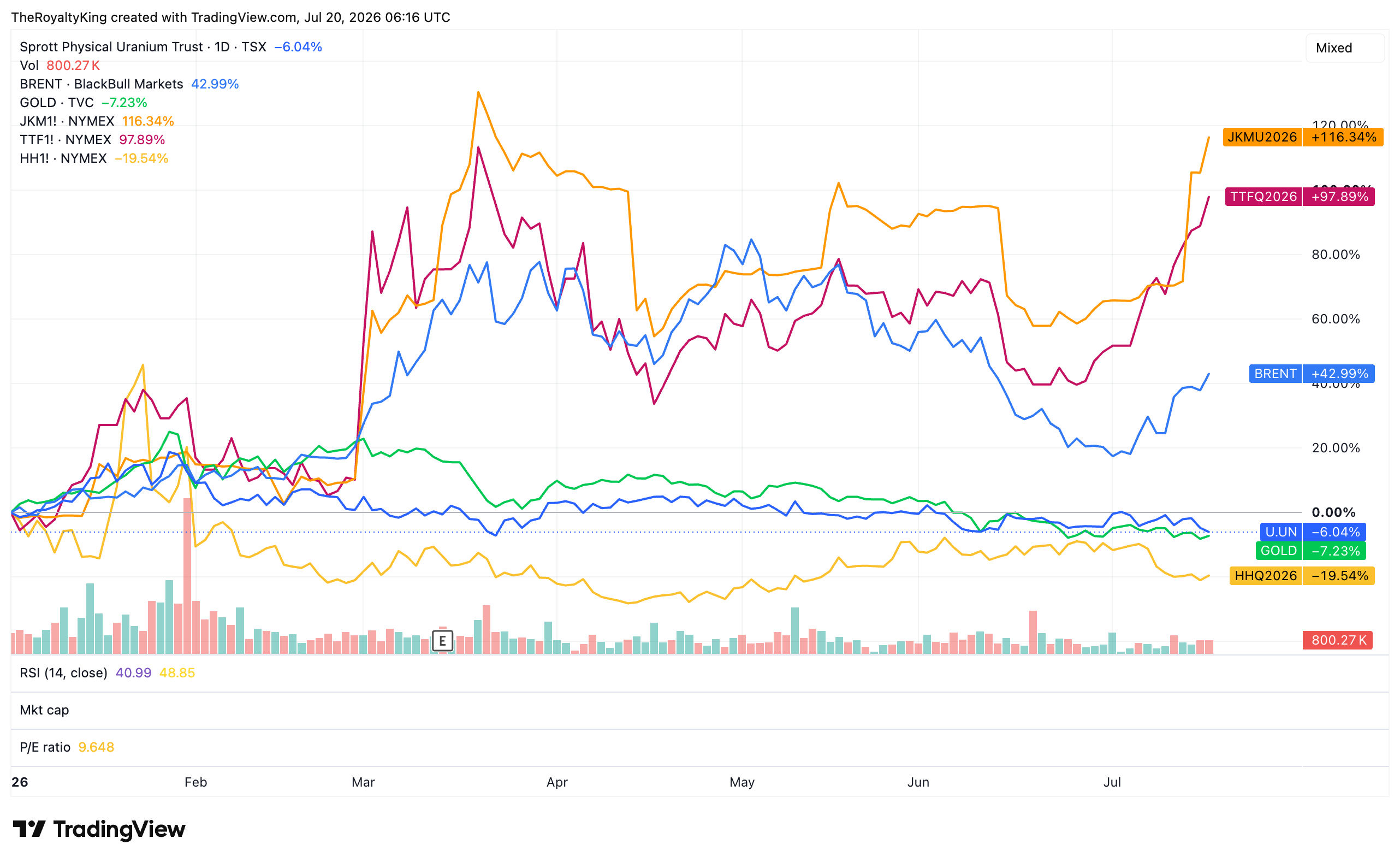
The U.S.–Iran ‘ceasefire-with-middle-eastern-characteristics’ didn't hold and rumours of strikes involving infrastructure not just in the gulf but also in Russia seem to be hitting the newsfeed recently. Brent is up a moderate +46% YTD, yet flat over three months, having round-tripped from a spring spike back to pre-war levels before this latest flare-up pushed it back toward $86.
The real move is in gas: TTF (European) is up +98% YTD and JKM (Asian LNG) has more than doubled at +116%, both driven far harder by Hormuz-transit fear than crude itself LNG cargoes are more exposed to a chokepoint closure than diversified crude flows. Counter-intuitively to most, but not readers of The Royalty King, U.S. Henry Hub, insulated by domestic supply, is actually down YTD 20.5%! (Co-production dynamics which have been discussed at length).
Of further interest, is that despite the clearly bullish news for Uranium as a strategic resource, SPUT (U.UN) is also down YTD and down over 10% over the prior 3 months. I prefer using SPUT as a proxy for the spot market here as it gives more insight into retail sentiment than the UX1 futures.
Cheap Producers, Different Grades
I’m known for my fondness for buying royalties and toll-booths, yet in the Crassus Investments portfolio I have no specific mandate. Circumstances being what they are, and being well-stocked with royalties in The Royalty King Portfolio, I’ve been searching through the cheapest quality claims on a barrel I can find. Here’s how four names on my radar stack up right now. Only two of these are genuinely vertically integrated; the other two are pure-play upstream optionality, and that distinction matters for anyone looking to hand around in this sector for a while.
Shell (SHEL) — Integrated. Full chain: upstream, refining, LNG and an in-house trading unit. Trading IMO ~8x fwd earnings, ~3.5-4% divvy and running an active $3bn buyback tranche through July. Just added ARC Resources to the upstream book. This is the “quality when cheap” case in its purest form: a diversified major at a mid-single-digit multiple with capital returns running hot.
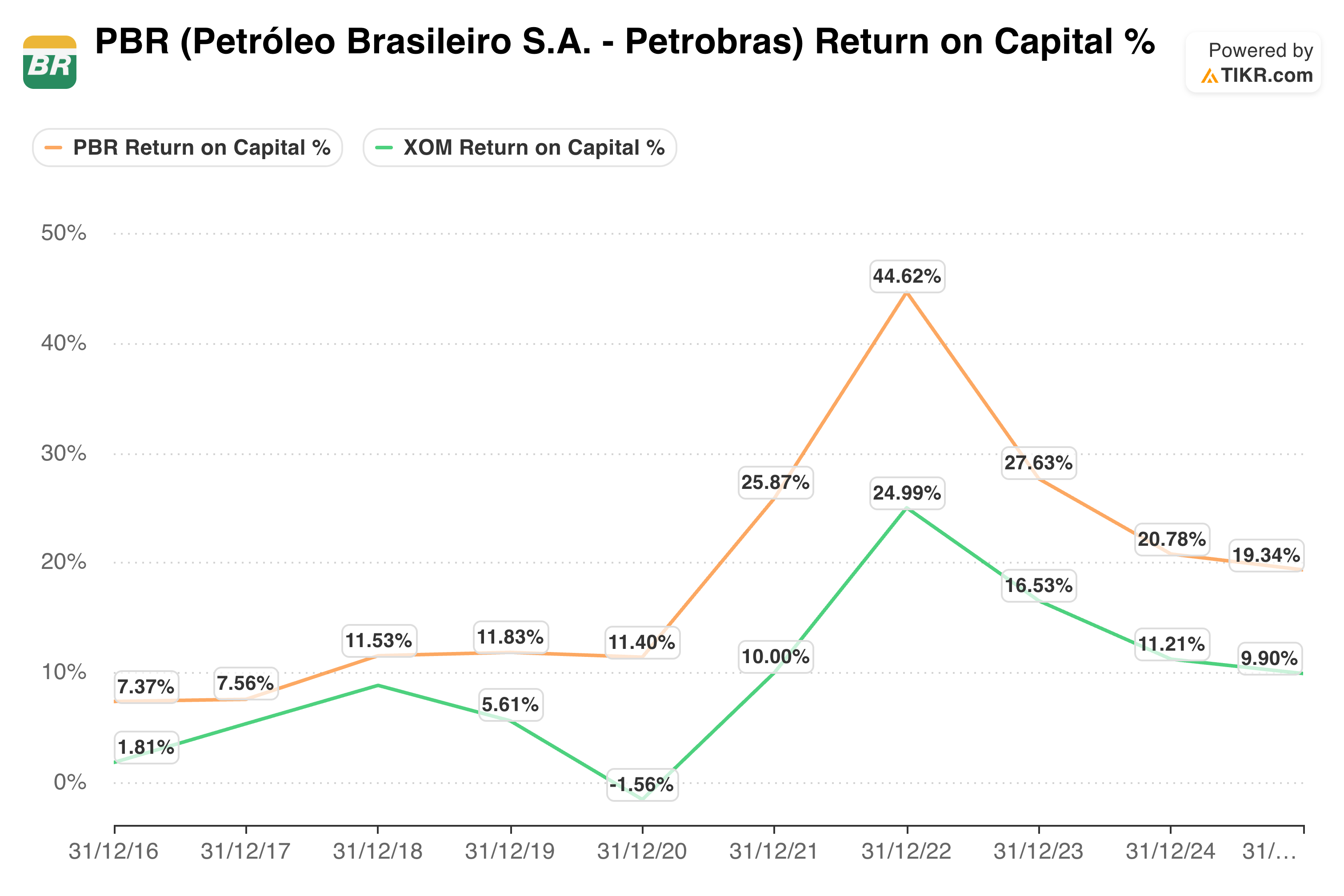
Petrobras (PBRA being my preferred share class) — Integrated Brazilian SOE. E&P plus ten domestic refineries plus distribution. ~6-7x earnings, yield bouncing 5-9% depending on distribution timing. A $109bn 2026-2030 capex plan, but PBRA has demonstrated a quality of capital investment that’s severely under-rated. In fact, you may be surprised to learn that PBR’s return on capital has far exceeded that of Exxon (XOM) — Uncle Rick’s benchmark for the sector (shh, don’t tell him!).
With elections in Brazil this year, a political cloud sits over the multiple re-rate.
Harbour Energy (HBR) — Pure-play E&P Not integrated, but so cheap I had to buy! North Sea plus new US Gulf and Argentine barrels post-LLOG M&A. IMHO the most important number is their 2026 FCF guidance, which just got revised from $0.6bn to $1.4bn on higher realized Brent/gas, implying a P/FCF approx 2.5x current run-rates and a trailing yield north of 6%. This is a leveraged-to-the-commodity price name, it’s been a while since I bought such a speculation but it’s so cheap I had to make it a small-but-meaningful position.
Given Argentina lost to Spain and I now owe Hugo Navarro a visit, the cashflow from HBR should suffice. He may also wish to look at this due its market cap being only 4.2 Billion GBP.
PetroTal (PTAL) — Pure-play E&P Small-cap Peruvian producer. ~$280-370m market cap, nothing other than a wickedly cheap barrell-pumper.
It’s cheapest of the 4 at prima facie but the smallest, least liquid, and most binary of the four given there’s a ton of risk: single-basin, single-pipeline export risk, landslides affecting their platform, Peruvian politics etc. etc.
However, at <0.66 BV, no net debt and positive net income (just), technically there’s an argument to be made that this is a net-net that’s —strangely— also an inflation beneficiary over the short term.
Bottom line: Shell and Petrobras are well known and have been good to me.
Vertically integrated, diversified cash-generative majors trading at multiples that don't reflect their balance sheets. Harbour and PetroTal are cheap for different reasons: real FCF inflection in Harbour's case, pure optionality in PetroTal's. All four benefit from the current risk premium, but only two of them keep the thesis intact if Hormuz calms down again.
To be successful, all great managers must adapt to the state of play. Today’s note was to update you on my recent additions to the team and slight moulding of the short-term tactics. Hopefully I’m a little more versatile than Scaloni, but then again, it’s easy to criticize.
As for TRK and TCC portfolios, nothing has changed there in terms of philosophy. I continue to hold quality royalties and exchanges and am practicing intelligent inactivity.
If you’d like access to my valuation and pirce targets for the above names and all the stocks I follow — become a premium member today. At only $125 yearly, that’s literally 35 cents per day! I mean — Come on!.
Until next time.
— Benjamin

PS: I write this publication for readers willing to look past a twelve-month clock. The best way to find more of them is through you. So this month, one reader will receive a free 12-month premium subscription simply for sharing this piece. If the winner is a current subscriber, their subscription will be comp’d for a year.
How to enter — each action counts as one separate entry:
Restack this dispatch on Substack Notes
Share it on Notes with a comment — a line on what stood out, agreement, disagreement, all valid
Quote-share on X, tagging @TheRoyaltyKing
Disclaimer: This publication is intended solely for documenting my personal journey with trading and investments for income and travel purposes. I am not a certified financial advisor nor am I a financial professional and none of the content provided should be construed as investment advice. It is essential to conduct your own thorough research and consult a registered financial service provider for appropriate guidance. I cannot guarantee the accuracy or completeness of the information presented. Any actions taken based on the information shared in any of my work are done at your own risk and discretion. The author may hold positions in the assets mentioned.
$CVE and $SU are worth a look in my opinion. Both are fully integrated with refining in the heart of North America. Also they both have 30 years of reserves and are near debt target inflection points where they will go to 100% fcf to sh.