

Read The Entropy Trap to discover what physics knows the economics doesn’t.
Last week I had the pleasure of speaking with Mr Dan O'Flaherty, CEO of Versamet Royalties Corporation (VMET).
Subsequently I’ve performed a deep-dive report on the company that’s available below. Before reading the report, I encourage you to listen to the interview where Dan does a great job of providing details about the company that might not be so obvious and that I believe the market is missing (for now). There is a specific, transformational catalyst emerging in 2027 that will unlock an enormous amount of value for the company and propel VMET upwards in its peer rankings.
THE ROYALTY KING REPORT
The Gold Series · 23 October, 2026.
Versamet Royalties Corporation. NASDAQCM/TSX: VMET
TRK Rating — I’m buying.
Executive Summary
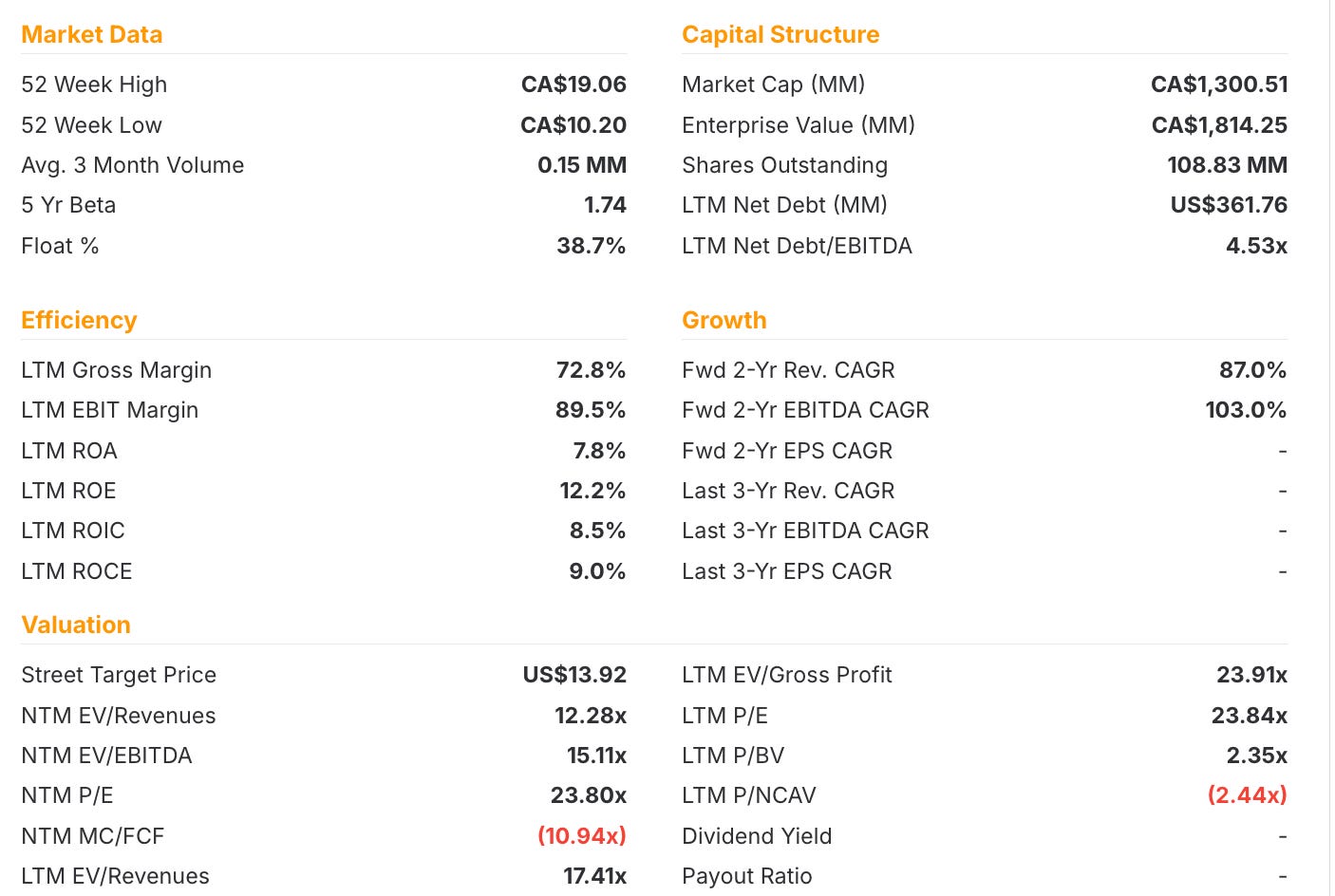
Versamet is a Royalty and Streaming company focused mainly on precious metals. It is the youngest of the mid-tier precious metals royalty & streaming companies and has swiftly assembled a 29-asset portfolio backed by B2Gold, Tether and the Lundin family. 7 of the assets are already in production.
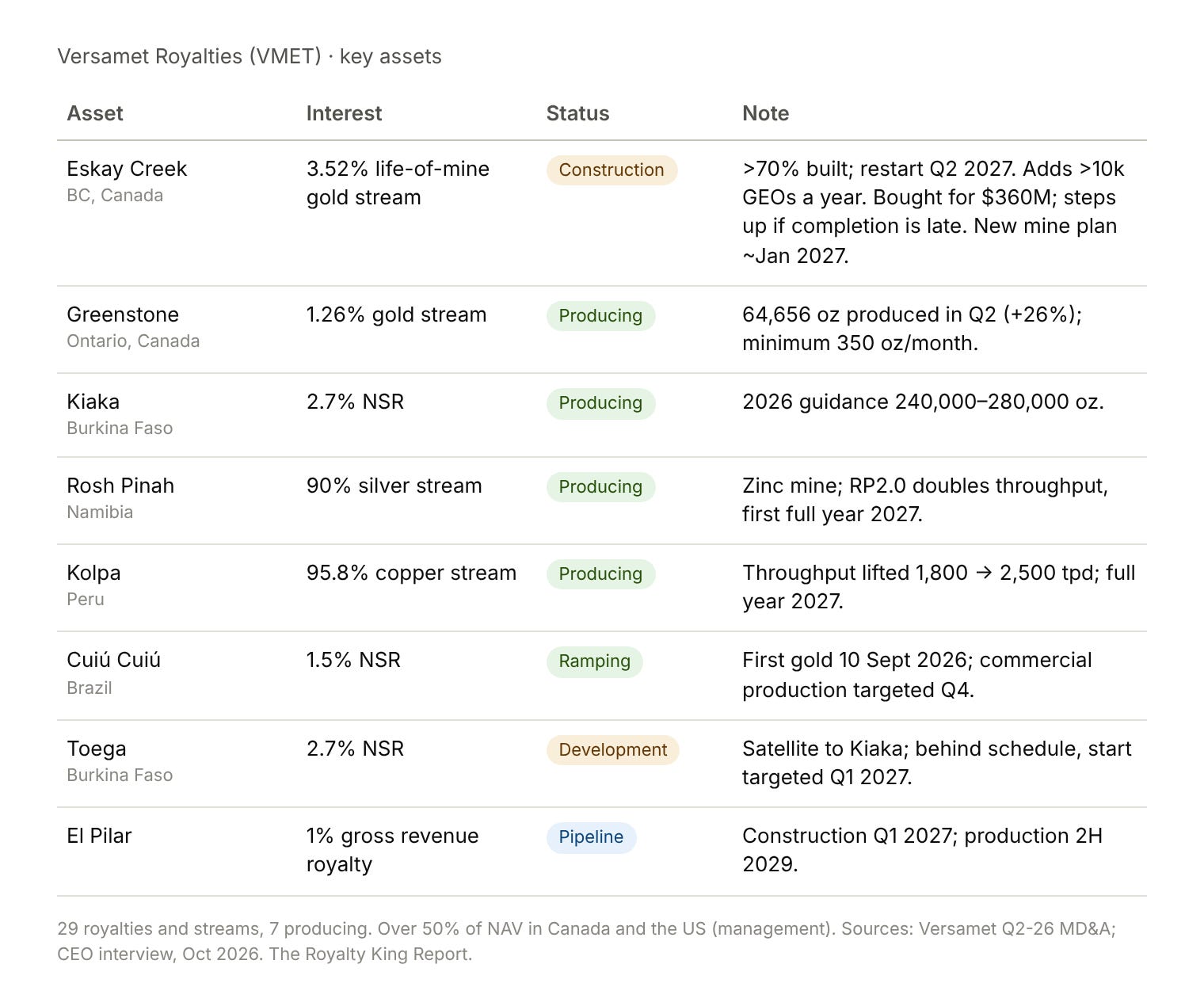
Q2-26 was its best quarter yet: 5,255 GEOs (+256% YoY), $23.7M revenue and $18.8M adjusted EBITDA, with a 20.6% net income margin. Its initial strategy has been to buy already cash-flowing assets and fund growth via debt. $375M was recently drawn down for the purpose of acquiring the Eskay Creek stream which promises to be transformational for the company, taking production levels from a guided 21,500 GEO in 2026 to an anticipated 40,000 GEO by the end of 2028.
The stock price trades near its post-listing low, down ~28% in six months, in contrast to the business performance which, based on its claim on GEOs, is marching upwards at a rapid rate.
The Disconnect: the market in its myopia is pricing today’s earnings plus the debt. It isn’t pricing the steep inflection of cashflows that are set to occur when those non-producing assets come online and provide a huge addition to the bottom line.
Such a disconnect is common in the type of assets featured in this publication — particularly the royalty companies — as the expected, almost windfall profits, materialize outside of Wall Street’s (and Bay Street’s) time preference (and bonus calendar).
Corporate History
Originally known as Sandbox Royalties and formed in 2022 by Sandstorm Gold Royalties and Equinox Gold, the company was seeded with royalties across Europe and the Americas. The big step-change came in 2024, when Sandbox bought a portfolio of 10 royalties from B2Gold for a consideration of $90 million which was paid entirely in shares, leaving B2Gold as the largest shareholder of the company with 33% of the shares. The company changed its name to Versamet Royalties in 2024.
Key Assets
Below I’ve taken some notes on the top assets held and put them together in a table.
Investment Thesis
For investors who believe in gold for the foreseeable futureVMET offers a unique combination of leverage. Production leverage: mainly via Eskay Creek which likely lifts EBITDA from about $75 million to roughly $115 million at today’s $4,000 gold price.
Financial leverage: The debt that funded the business is fixed in nominal dollars, while the metal that repays it is not. Debasement lifts the dollar value of each gold ounce, widens margins on a largely fixed cost base and shrinks the real burden of what the company owes. The following situation emerges over time: More ounces, each in turn worth more, with a shrinking claim ahead of the equity.
Even using modest assumptions: 15× EBITDA and $4,000 gold, the shares would be worth around $14.20 by end-2029, some 80% above today’s price thanks to increased production. Of course, that figure assumes no further rise in gold, which is the very premise at the heart of the trade. The below chart illustrates how a 10% increase in the gold price can disproportionately increase the equity value.
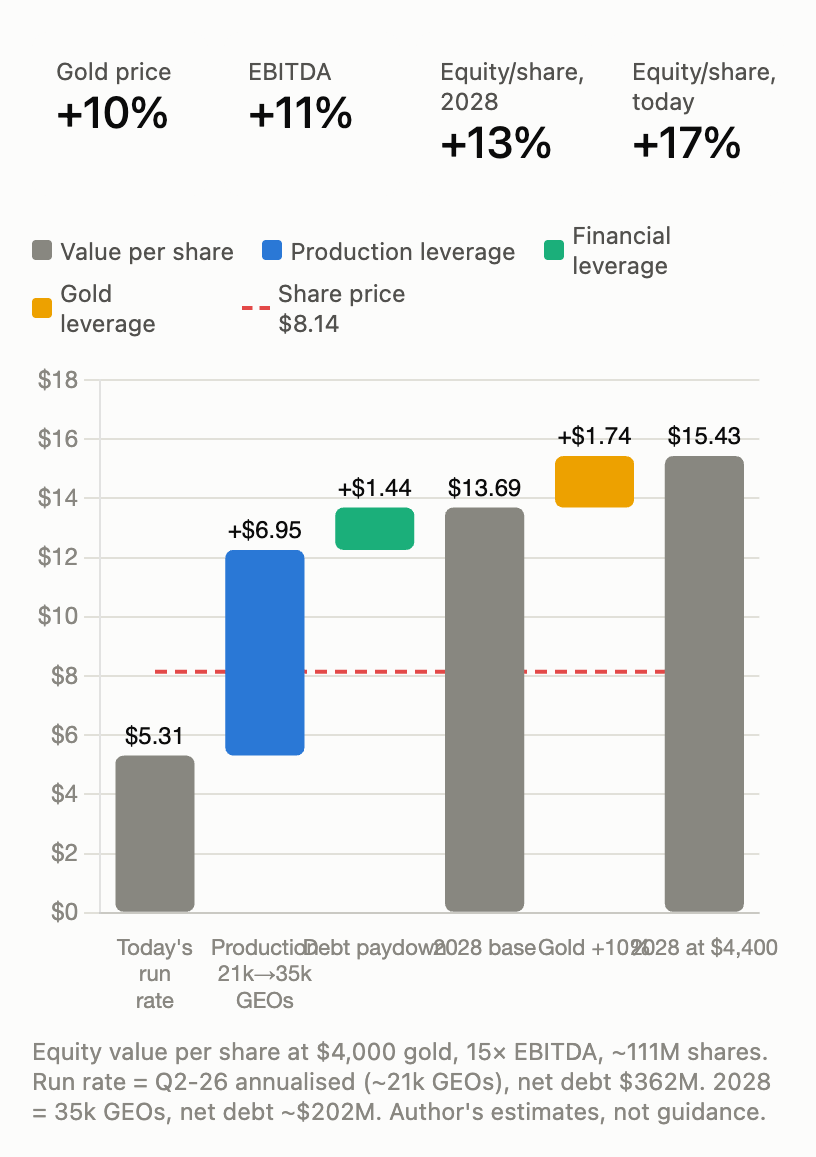
Leverage cuts both ways of course. Approximately 25% of future volume rests on one mine starting on time, and net debt sits 4.8x current EBITDA and a bullet repayment is due in March 2028. Should Eskay slip while the gold price drops, the leverage would be amplified in the opposite direction. This type of leverage, however, is preferable to me as opposed to the type of commodity price leverage typically exhibited by those marginal cost producers who experience massive torque to their margins in bull cycles, but bleed cash during a downturn thanks to the capital-intensive nature of production.
Consider B2 Gold, with its 6,327 employees, which generated ~$3 Billion in revenue last year — that’s $474,160 per employee at a net income margin of 13% (and that was in a record year for gold). Now contrast that with VMET’s 8 employees required for 2025’s revenue of $34.76 million ($4.4 million per employee) and it’s easy to see how one of these business models can weather a bear market in commodities while the other cannot. The royalty’s leverage is intelligent and anti-fragile, the operator’s is fixed and fragile.
The standout objection from the market today appears to be the debt: $375M drawn against $13.2M of cash, with a $40M bullet due in March 2028.
Versamet has done this before and with success. It borrowed to buy Greenstone and repaid it from cash flow. It borrowed for the Appian portfolio and paid that down too, albeit partly through the February 2026 equity raise. Eskay Creek is the third application of the same tactic: borrow against a quality asset and let the asset repay the loan over time.
On my base case — with Eskay in production— VMET generates >$90M a year of free cash flow. That covers the bullet comfortably and cuts net debt to roughly $120M, or roughly 1× EBITDA, by the end of 2029. Buybacks may be 1-2 years away if all goes to plan.
The real risk is timing. If Eskay slips just as gold falls, Versamet stays levered for longer and may have to issue shares near the lows. That’s the bear case IMHO and I’ve priced it as such below in the valuation model.
The story in brief:
Think of VMET as young toll-booth operator that borrowed to buy its biggest toll road. The economics are the classic royalty model; The company distinguishes itself from peers in its agility and strategic shareholders
Of course, judging royalties on a 2 year outlook is antithetical to owning royalties. Therefore, let’s examine the portfolio of assets and underwrite a full cycle bear-base-bull case as taught to me by the great Rick Rule.
Valuation
Let’s start with the easier, yet less complete valuation method underwriting a line-of-sight production estimate of 3 years and combine that with a blended commodity price matrix.
VMET’s production share is estimated to reach 40,000 GEO by the end of 2028. I’ll underwrite that as the bull case and haircut production slightly for the base and bear cases. The gold price at time of writing is almost exactly $4,000 so, in the interests of conservatism, I’ll use that as the base for the price matrix and flex it up/down by 20% as Uncle Rick does. Screenshotting my scribbles and asking Claudio to put them together in a more visually appealing form results in the following.
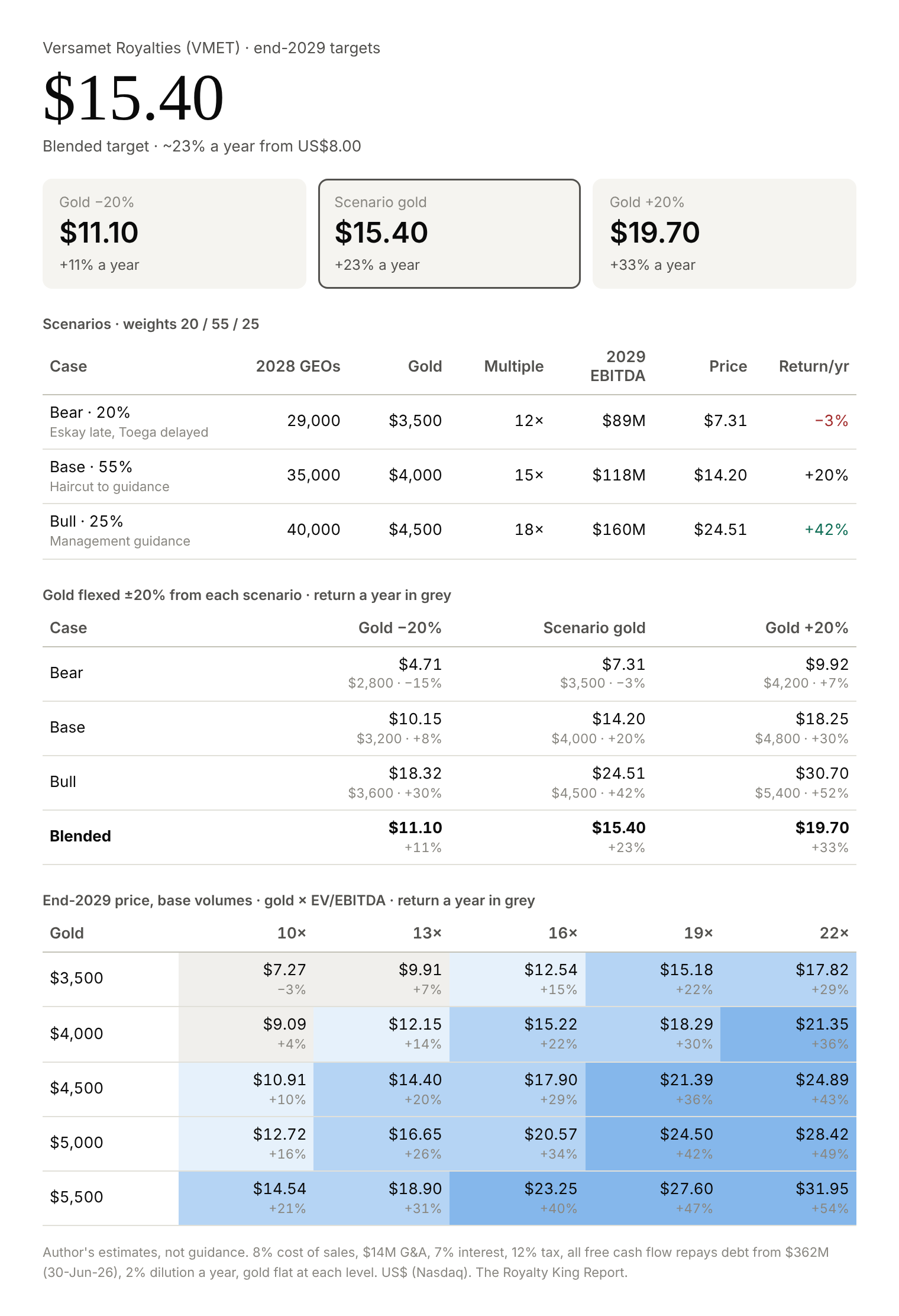
A blended base case target of $15.40 by the end of 2029 seems quite reasonable to underwrite and implies an ARR of 23% before any multiple expansion.
Speaking of which, it’s obvious that VMET has some room to grow into in order to catch up with its peers in terms of comparable valuation multiples.
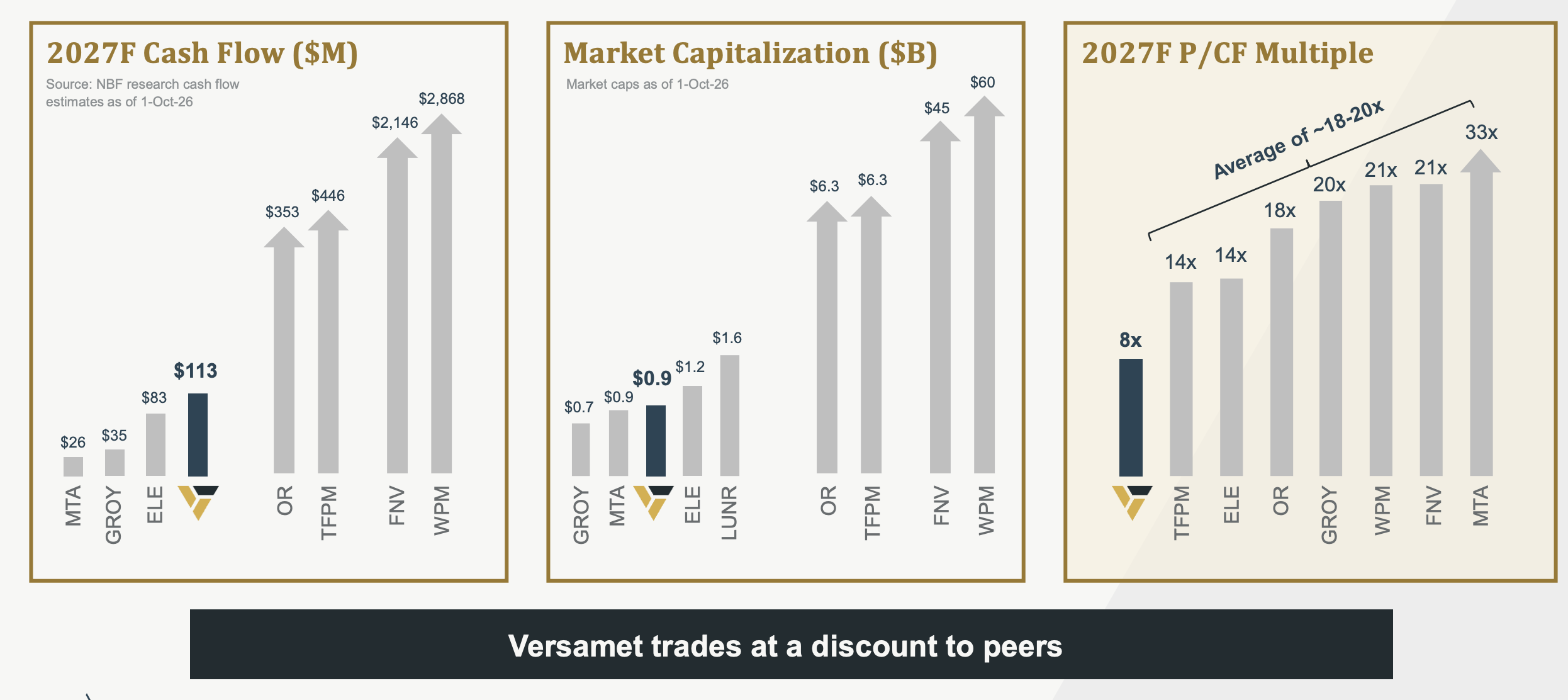
As you know, I tend to be rather bullish on the gold price outlook over the next 3-5 years and hence I tend to view the above table with an eye towards the mid-bottom right of the valuation matrix. Those ARR % numbers are certainly attractive.
At ~$8 today, the market is paying for today’s earnings plus only a fraction of the Eskay Creek step-up — and nothing for a higher gold price.
Using a very conventional NAV, which holds gold flat at $4,000 and discounts at 5%, Versamet’s existing portfolio is worth about $6 a share after debt, so at ~$8 you’re paying roughly 1.3× NAV. But a flat gold price over 25 years implies gold falls in real terms, which is the opposite of my thesis. If gold merely keeps pace with inflation, I see NAV today closer to around $9. Ergo, at today’s price you’re buying the existing portfolio at a discount, with management + the pipeline and any future deals thrown in for free. That’s also before mine-life extensions, which royalty holders get for nothing — which is the topic of a future report.
Catalysts to Watch
New Eskay Creek life-of-mine plan (~January 2027)
Toega start (Q1 2027)
Eskay first gold (Q2 2027)
First full year of Rosh Pinah 2.0 and the Kolpa expansion (2027)
First buyback (Potentially ~late 2027)
Further index inclusions
Closing Comments
Around $7 is the price at which I’d be paying nothing for Eskay Creek. Should we have a nasty sell-off, at that level I would heavily add depending on the opportunity set at the time. Beyond 2029, with debt largely repaid and $100M+ per year to recycle into new streams, VMET has the makings of a long-term compounder at 10–12% a year on top of gold’s performance.
Until next time,
All the best.
Benjamin
Disclosure: I own VMET in The Royalty King portfolio.
Disclaimer: This publication is intended solely for documenting my personal journey with trading and investments for income and travel purposes. I am not a certified financial advisor nor am I a financial professional and none of the content provided should be construed as investment advice. It is essential to conduct your own thorough research and consult a registered financial service provider for appropriate guidance. I cannot guarantee the accuracy or completeness of the information presented. Any actions taken based on the information shared in any of my work are done at your own risk and discretion.