

Read The Entropy Trap to discover what physics knows the economics doesn’t.
A croupier doesn’t pick winners. The house has an inbuilt edge and takes its expected share over a large number of transactions at each table. Most of this publication concerns businesses of that kind: exchanges, royalties, toll roads etc.

Another sub-category of hybrid-croupiers exists in the financial services sector. Here, each company takes a toll on transaction such as: card payments, Pix transfers, cross-border FX etc. They also are involved in lending, and lending is where the market’s attention has settled on today’s constituents.
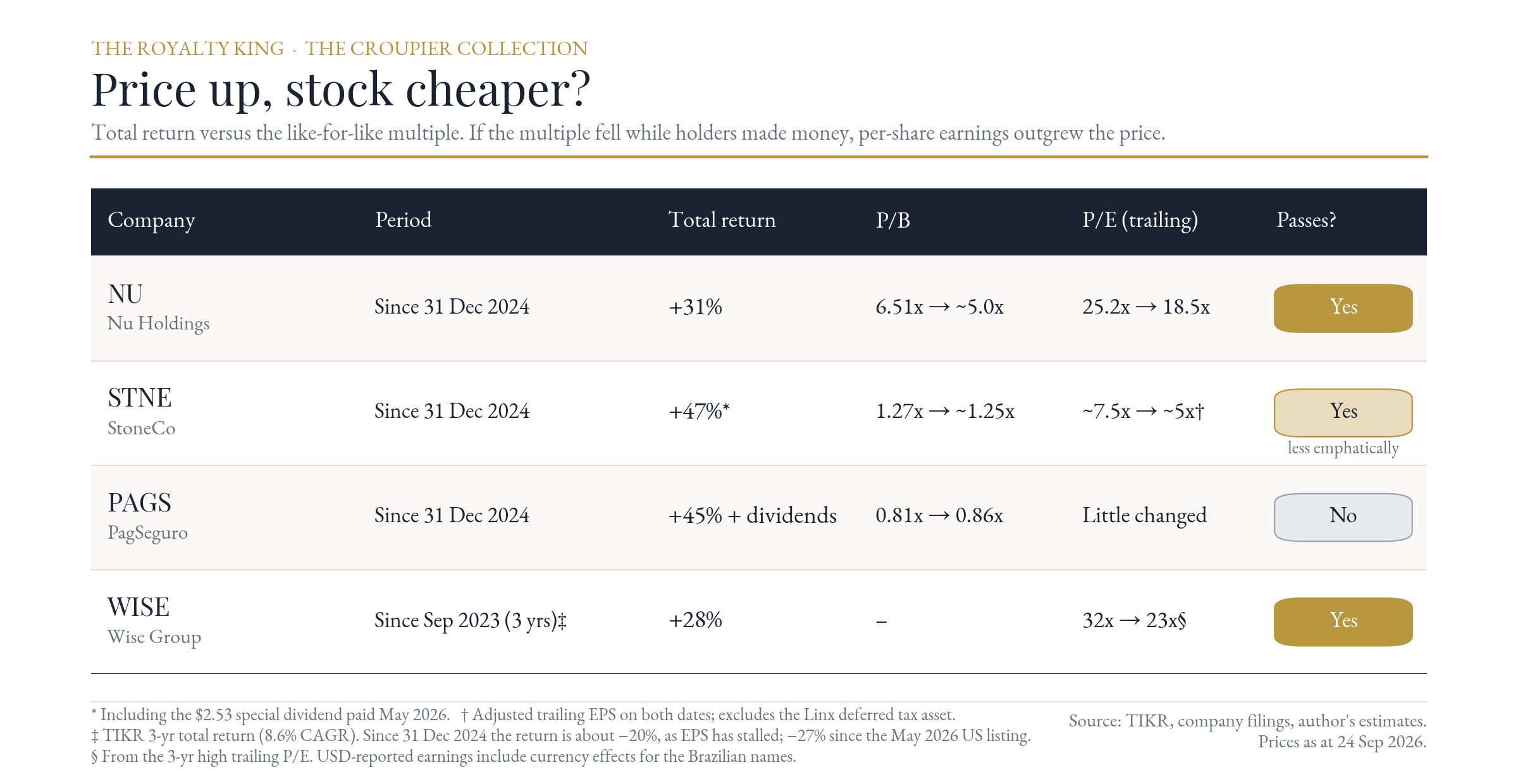
The idea I want to impress on you in this mini-series is simple. A business can earn enough on its equity to deliver a very satisfactory return without the market ever re-rating it with higher multiples. Its share price can even rise while the stock becomes cheaper, because the business compounds faster than the price. Two of today’s four names have done exactly that since the end of 2024. They compounded, returned a great deal of capital to shareholders and yet the market actually pays less now than it did before. In my experience that doesn’t persist indefinitely, albeit it can persist for longer than seems reasonable.
Lending aside, these businesses clip a ticket on volume: every card swipe, Pix payment and cross-border transfer can be seen as a small toll.
This matters in Brazil — home to 3 of the 4 names covered today. Inflation and pessimism has compressed the multiples the market will pay, but it also inflates the nominal value of volumes flowing through the pipes. A toll priced as a percentage of volume rises with prices automatically, much like a royalty.
Higher rates can lift lending yields and the spread on customer float, which helps them given they are all banks of sorts. On balance, the inflation depressing their multiples is quietly inflating their earnings base and they appear to have put in a low from which they are likely to climb quiet high and quiet quickly thanks to the mathematics of base effects.
The 4 names are ranked by market cap, with 3-year scenarios for each. In the base case the multiple never moves. In the bull case it re-rates towards a normal level. In the bear case earnings fade and the multiple falls to its 5-year low, basically where we already are today. That is what lets me underwrite a reasonable expectation of an unreasonably good return.
A select group of unloved croupiers:
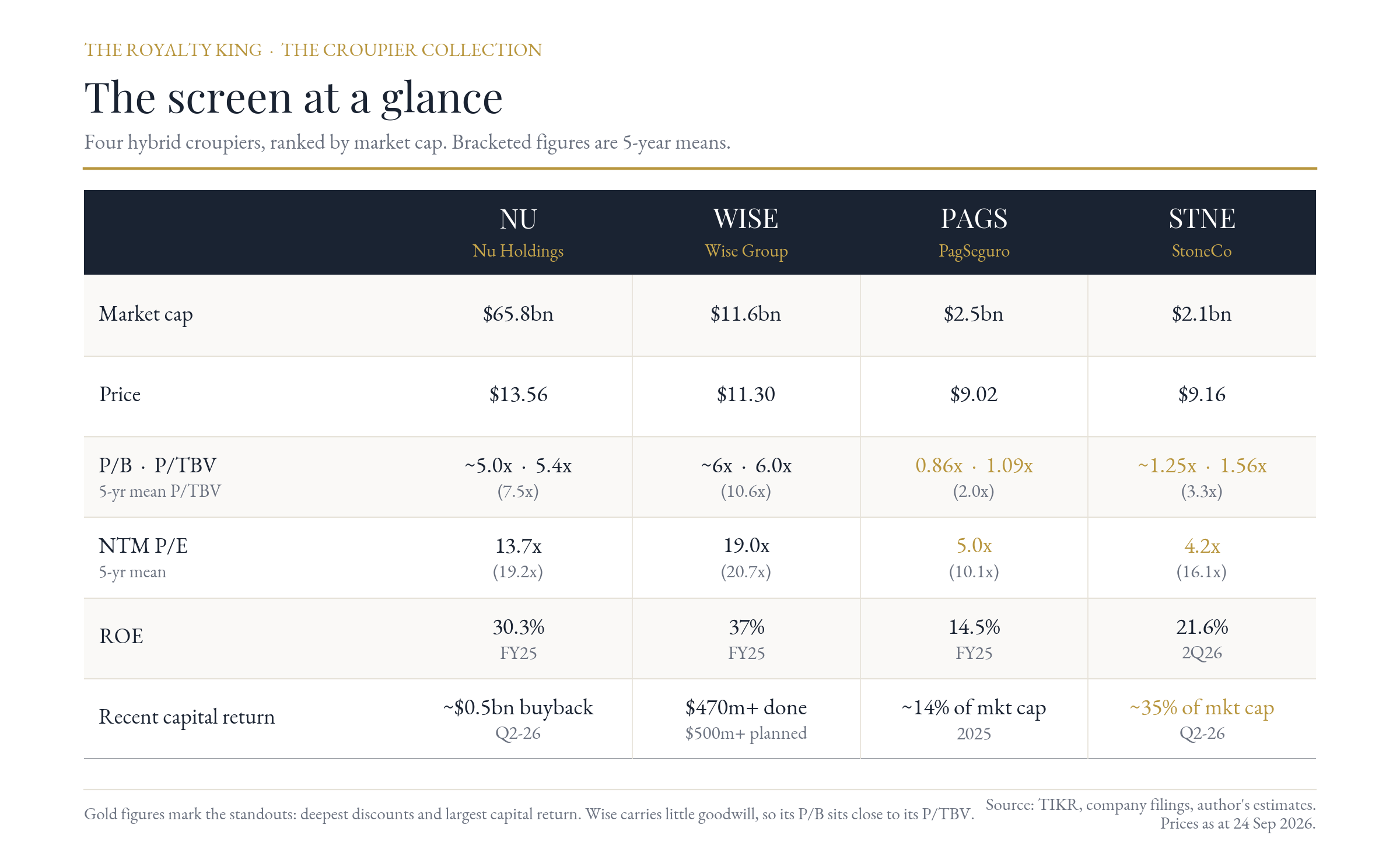
No love towards WISE has been lost on my behalf since they forced me to close my account with them due to my receiving portfolio management fees from Crassus Investments — a portfolio that holds cryptocurrency and hence went against their policies. However, with my investor’s hat on, the 25% decline in price over the last 5 years presents an interesting opportunity. PAGS and STNE I am familiar with, having owned both off and on over the years.
1/ The balance-sheet lens
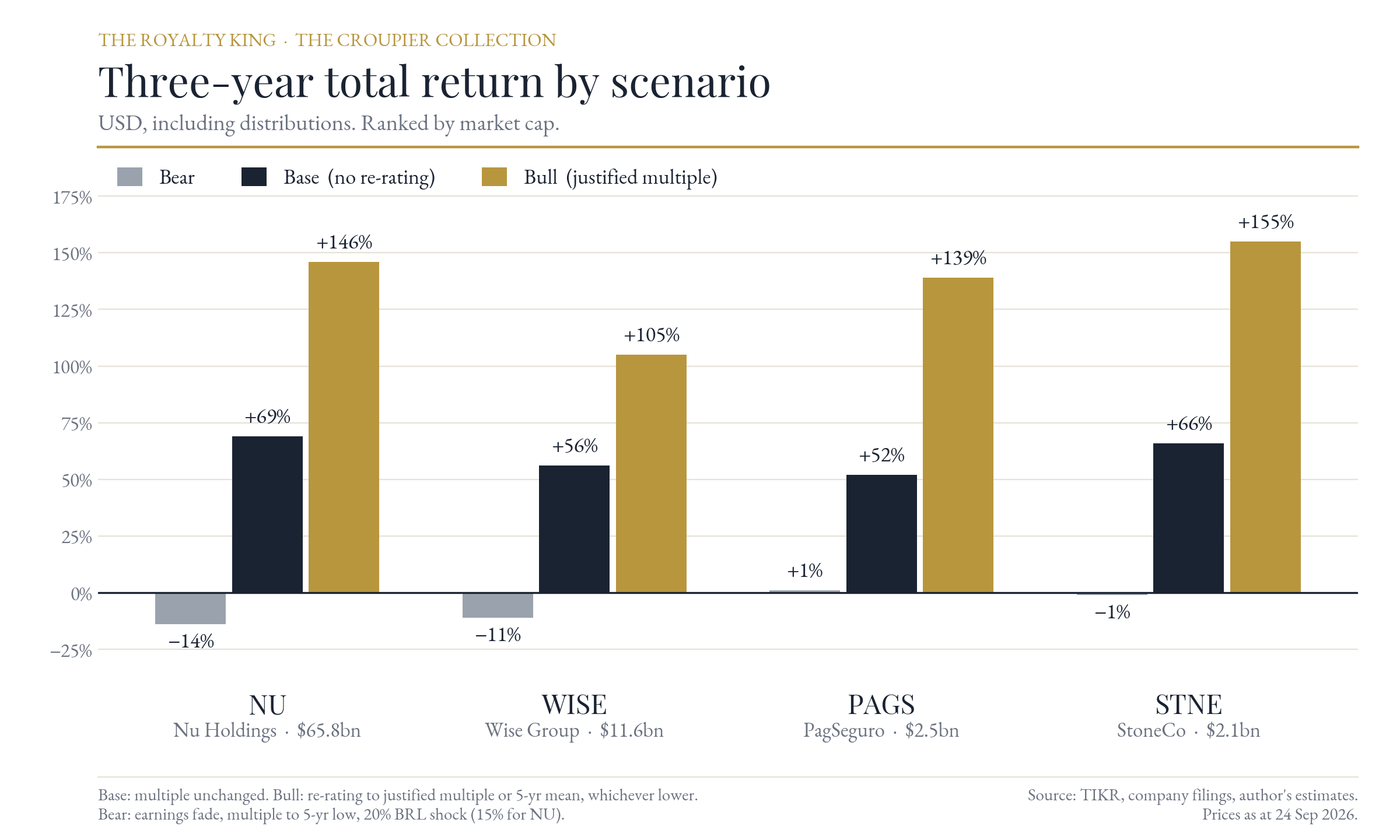
Chart 1 values each business on its tangible book value (TBV) which is what a shareholder actually owns once goodwill and capitalised software are stripped out. It then asks what multiple of that book the business deserves, given what it earns on it. EG: A company earning 30% on equity, when investors require 16%, should trade well above book. One earning only its cost of equity should trade at about book. Banks have been valued this way for a century, because book value is audited, slow-moving and hard to flatter.
Yet, it doesn’t appreciate a company buying back a fifth of its shares at 4x earnings. It also understates the bear case, because in a real Brazilian credit downturn, earnings fall first and provisions then eat into book.
2/ The Earnings Lens
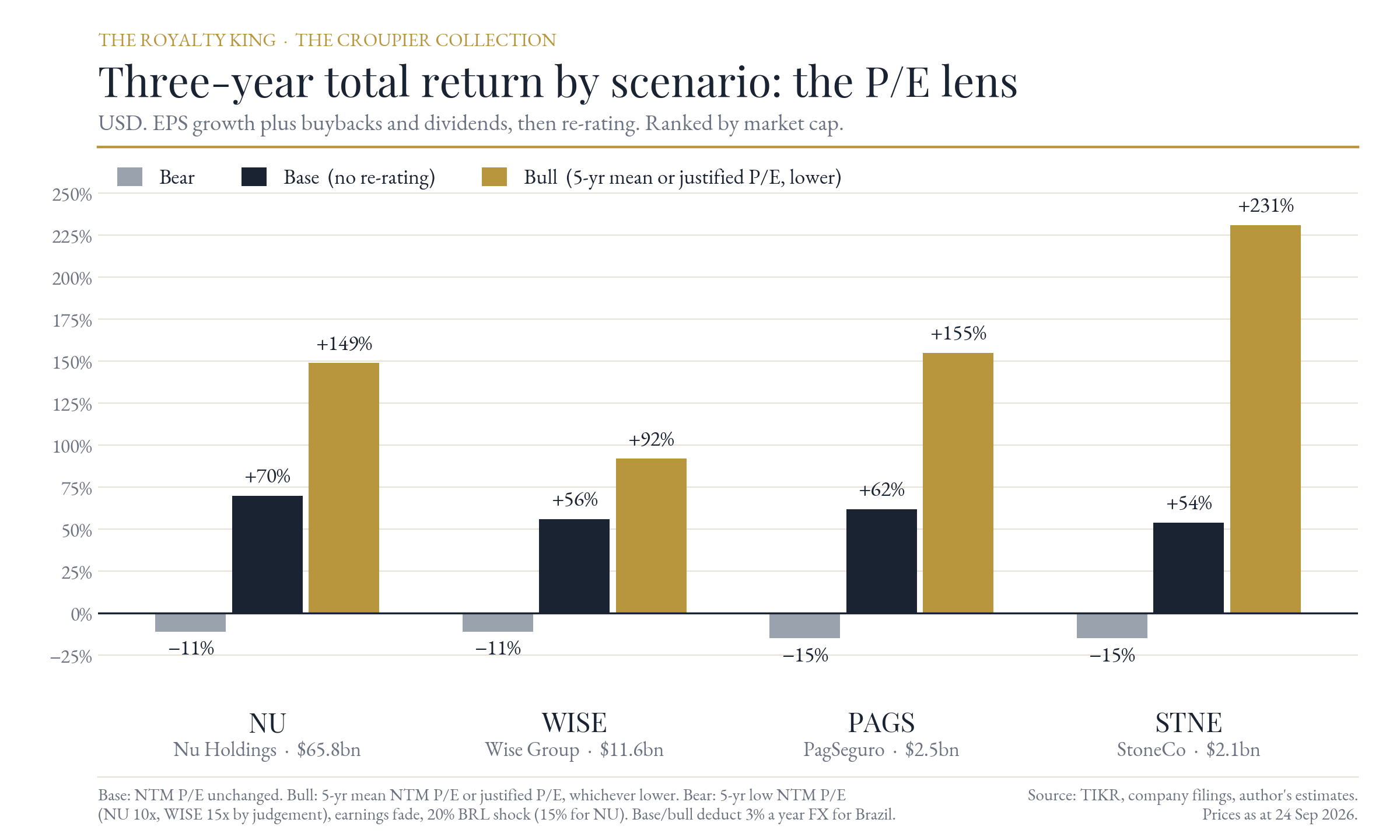
Chart 2 builds the return from the ground up: earnings growth, plus buybacks, plus dividends, then any change in the multiple. It’s more sensitive. It captures the full force of buybacks at 4–5x earnings, which is why the bull cases for PAGS and STNE are larger. It is also harsher when earnings fall, because at 5x there is little room for the multiple to absorb the damage.
Which Is Better? Book value tells me what I own; earnings tell me what I’ll be paid for owning it. For the lenders, book is the better anchor, being less exposed to currency swings and one-off items. For WISE, which carries almost no book, only earnings mean anything. Bottom line for the TLDR crowd: Taking the more conservative answer from each lens:
PAGS and STNE offer 50–65% in the base case.
Each carries a realistic bear case of about −15%.
The bull case sits somewhere between 140% and 230%.
Price up, stock cheaper?
For illustration of the concept introduced above, the test I apply is this: If shareholders have made money while the like-for-like multiple has fallen, then per-share earnings have outgrown the share price. That is: the company is actually cheaper even though the stock price is higher.
(Some) Risks
The Brazilian credit cycle. A wave of defaults means earnings and book values take a hit.
Currency & Interest rate risk. A higher-for-longer Selic squeezes the acquirers’ funding costs, and a sharp fall in the real erodes dollar returns. The reverse is also true.
Pressure on the toll. Pix is eroding card fees in Brasil, regulators may cap rates and fees, and Wise is cutting its own prices.
The wildcard: Stablecoins. Instant dollar transfers via tokens evade the banks completely. That is a first-order risk for WISE, perhaps a lesser one for the Brazilians. This is the one risk that could redraw the table rather than simply shift the odds.
With the introductory framework in place, company specific notes are provided for each name as well as my personal ranking. Become a premium member today for access (the annual subscription works out to 34 cents per day!).
