

Read The Entropy Trap to discover what physics knows the economics doesn’t.
WhiteHawk Minerals Corp. NYSE: WHK
TRK Rating — watch.
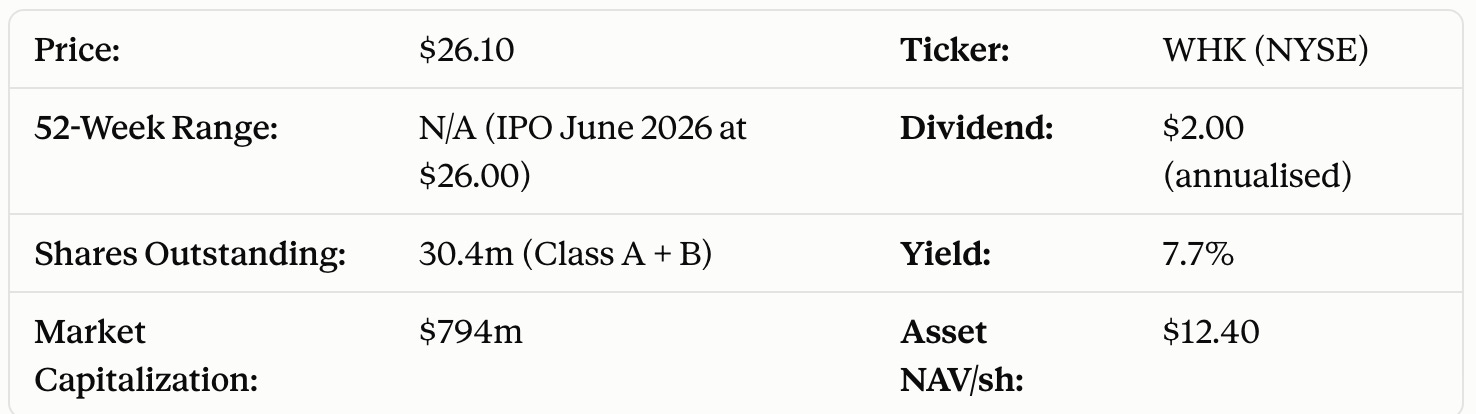
WHK is a new starter position in The Royalty King and Crassus Investment portfolios.
Executive Summary
WHK is a natural gas mineral and royalty company who, subsequent to their recent IPO in June 2026 claims the largest publicly traded natural gas mineral portfolio in the US. Its 3.6m gross unit acres across the most prolifically producing gas basins in the USA provides its shareholders with exposure to ~13% of all US dry gas production.
The majority of royalties owned by WHK are mineral interests which means, unlike the net overriding profit interests owned by another member of TRK portfolio — SJT — it is exempt from operating and development costs.
On assets alone, an unimaginative sum-of-the-parts valuation of WHK appears worth ~$14/sh. The market price today sits at ~$26 which at first glance makes the stock look less interesting with a P/NAV of circa 1.7x. Yet that premium is the key to its value creation.
Just as MSTR funds its buying of BTC via preferred stock and equity raising when the P/NAV = >1x, WHK intends to use a similar mechanism to fund its acquisition of private acreage, tucking it into its assets and receiving a double-bump via a royalty from field operators and a higher multiple awarded it thanks to its public-stock wrapper.
Today’s essay examines whether this multiple is appropriate given the value accretion shown by the company through its acquisition integration buying private minerals at ~6.6x cash flow and enjoying the arbitrage mentioned above.
What needs to happen to justify the multiple?
Any combination of three things:
Rising gas prices: specifically, sustained Henry Hub of ~$6.70+.
Moderate gas plus deals: ~$4.50 gas plus ~6 years of accretive deals.
Strip gas plus accretive deals: ~11 years of deals at today’s spread.
I view WHK at today’s price as a decent long term call option on higher gas prices in the USA. Its royalty model shields it from margin creep in its costs. An 8% dividend yield makes it an option with positive theta, meaning one is getting paid to wait for the tail event of rising gas prices to occur.
A large part of the valuation depends on the public-private premium persisting. In other words, that they continue to acquire private deals cheaply and are awarded with an expansion of multiples (private deals are usually priced at single digit multiples whilst public companies should trade at double digit premiums). The loop is somewhat circular: the premium funds deals, and deals justify the premium. This is not uncommon and is the secret of success of some well known royalty companies such as: FNV, WPM, Altius et al.
MSTR is probably the best known public company making use of a premium to NAV, raising equity to fund more BTC purchases. However, a key difference lies in BTC no paying any cashflows while WHK enjoys leasing and royalties on the assets it acquires.
Gas Prices — The All Important Variable
Betting directionally on gas prices has historically been a widow-maker of a trade.
Therefore, I prefer to get my exposure via select royalty plays which will provide a certain amount of insulation and prevent blow-up risk.
The ~8% yield offered currently by WHK is a good start and solves the time value of money problem. Yet the real upside lies in increased revenue (a product of price and volume) and increasing market multiples.
Here’s (an abbreviated) take on US domestic gas towards the end of the decade.
US gas heads into winter oversupplied, but demand is about to change. The EIA expects storage to end the injection season 5% above the five-year average, with Henry Hub averaging $3.43/MMBtu in 2026 and $3.28 in 2027.
Production keeps rising, led by the Permian and Haynesville. Permian gas comes out alongside oil, so it keeps flowing whatever gas prices do.
The demand wave arrives from 2027. The EIA sees LNG exports rising from 15 Bcf/d in 2025 to 19 Bcf/d in 2027, and another ~7.5 Bcf/d of export capacity is due by mid-2028. Data centers could add roughly 6.1 Bcf/d by 2030. They’re still a wildcard. Together, that’s 12–15 Bcf/d of new demand, or more than a tenth of current US output.
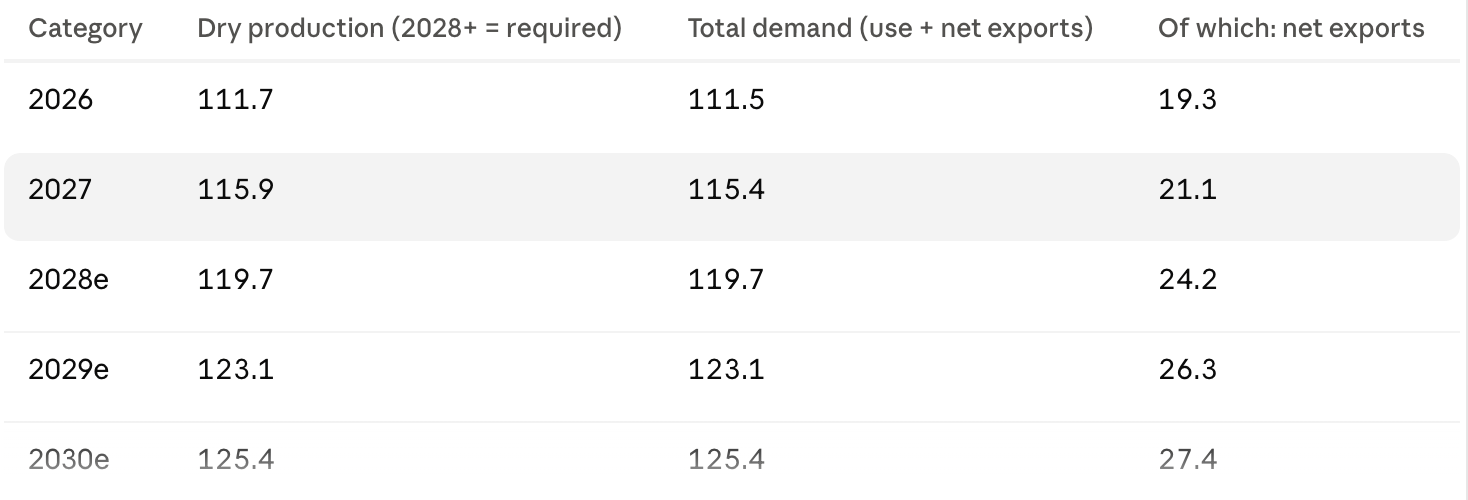
For WHK, gas price upside is most likely in 2028–30 just as its hedges roll off, so the timing could work in WHK's favour. The Appalachian caveat still applies as the tightness comes from Gulf Coast demand, and Appalachian gas has limited pipeline access to it. WHK benefits mainly from any rise in price rather than volume. A narrowing of gas spreads is something I deem inevitable, but not imminent, in a future global society thirsty for molecules.
The question that matters for investors is how much of the $26 share price is backed by assets and how much depends on management continuing to execute. Below the paywall I break that down: the full sum-of-the-parts model, NAV sensitivity from $3 to $6 gas, what the market is implying about the undeveloped acreage, the value of the acquisition platform in years of deal flow, and the exact price and conditions at which I'd buy in size.
