


Ahh, Las Vegas.
I’ve had the mis/fortune of visiting more than once back in my sports medicine days, whenever one of my athletes was fighting on a UFC card.
It’s a surreal place and not one I love: neon nights and slot machines etc
When you stroll back to your room at 5:30 a.m., and you see the same person is still at the slot machine they were playing when you went out the night before..
However, no matter how wild the night gets (and as I was in my 20’s - I have plenty of stories) it’s the casino or the house that always wins in the long run.
That lesson became fundamental to my options trading: I don’t want to be the gambler chasing a payout, I want to be the house, running a system where probability and discipline quietly stack the odds in my favour - I want to have the edge.

In my last piece, I wrote about the Wheel Strategy, a way to use short puts and covered calls to generate income. Most ‘lifestyle’ content creators out there would have you believe that selling covered calls on sh*tcos with high volatility premiums is enough to have you leave your job.

In reality, it’s all they know and in all likelihood it’s not enough on its own.
There’s so much more to what I do than simply selling puts and calls. Today I believe you’ll gain an insight into what separates the legit players from the chumps.
The wheel strategy works, but it can tie up a lot of capital and your chance of assignment can run over 50%. That’s fine if you want to own the stock longer term - but what if your focus is purely and simply cashflow?
For this purpose one of my favourite instruments is the credit spread.
This is where things get interesting..
The Maverick Life Mastermind is coming.
I’m opening up a small, private community for those ready to turn options into location-independent income and design a life of real freedom. Inside, you’ll get weekly calls, live trade reviews, and access to my full Options Income Engine framework — plus guest speakers and a network of serious peers. Spots will be strictly limited, and the waitlist is the only way to get early access and priority pricing.
What’s a Credit Spread?
A credit spread involves:
Selling an option` and buying another option further out of the money on the same side and same expiration date to cap your downside.
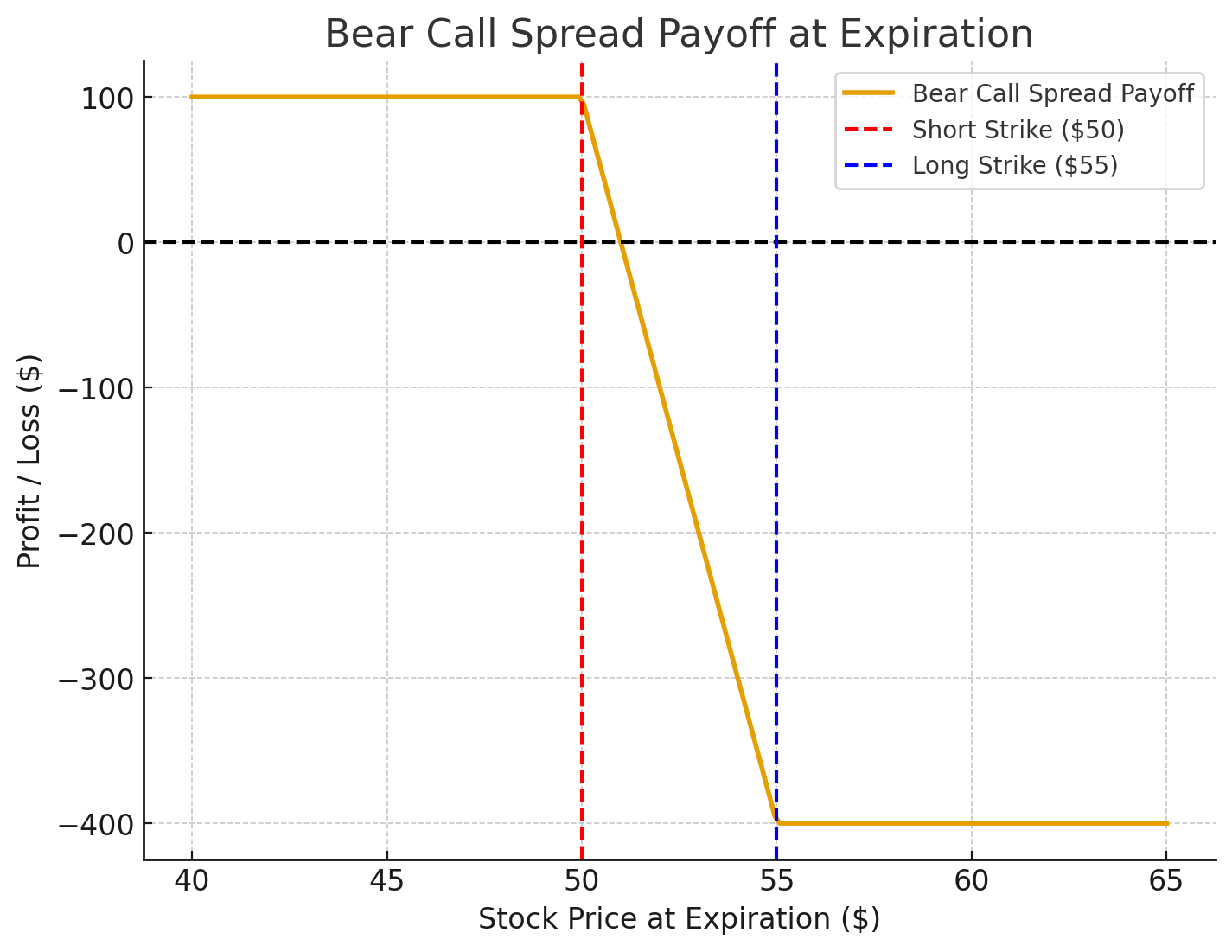
EG: I might believe a stock will be below $50 at expiration.
I could then sell a $50 call option and buy a $55 call option. If this results in a $1.00 credit (determined by market pricing), my max profit is $100 - realised if the stock closes below $50 at expiration. The maximum potential loss is $400 - realised if the stock closes above $55 at expiration.
I liken it to selling insurance and then buying protection on that insurance (re-insurance as it’s known).
I collect a net credit upfront - the maximum profit is the premium received, while the maximum loss is the width of the spread minus that premium.
Unlike the Wheel, I never take possession of the asset. It doesn’t matter whether the underlying asset is “cheap” or “expensive” — valuation is irrelevant here.
I’m not investing, I’m engaging in statistical arbitrage for a profit.
And with experience, I’ve learned how to tilt these bets so the probabilities are stacked massively in my favour.
What I’m sharing with you today is worth its weight in gold
However, first we need to understand a few concepts.
Expected Value (EV)

Expected Value (EV) is the average outcome you can expect from a trade if you repeated it over and over. It accounts for both the probability of winning/losing and the size of those wins/losses.
This is where many traders go wrong: they focus on “probability of profit” (POP) (e.g. 90% win rate) but ignore the payout magnitude. EV is what actually tells you whether a strategy is profitable in the long run.
So in our above example, let’s say the $55 call strike had a POP of 30. That implies the market is pricing in a 30% chance of the call finishing in the money (ITM) or 70% probability of finishing out of the money (OTM) and hence worthless. Since I sold the call I hope it finishes OTM below the $55 strike and hence I have a 70% probability of winning.
BUT - that’s not enough, that’s gambling. As the casino owner or house, I need to calculate the expected value of the trade, in this case expressed as
P(max profit) if Stock < $50 ≈ 70% → +$100
P(max loss) if S > $55 ≈ 15% → –$400
P(between $50 and $55) ≈ 15% → payoff declines linearly from +$100 → –$400
• average payoff in this band ≈ –$150 (since it’s linear and breakeven at $51)
EV=0.70($100)+0.15(−$400)+0.15(−$150)=$70−$60−$22.5= −$12.50
Although the odds were in my favour - the EV is negative, meaning over time and on average I’d expect to lose -$12.50 per spread traded!!
No good!
So, what can I do? (apart from choose a different trade, because the market is generally efficient here and will usually give you a negative EV unless you’re trading volatile sh*tcos). I need an edge.
The Trader’s Edge
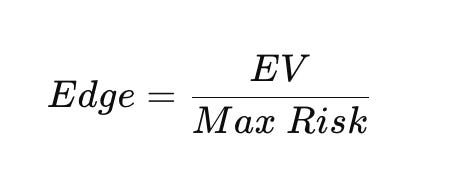
Edge is the positive expectancy you create when your rules, discipline, and execution tilt the odds in your favour. Without an edge, you’re just gambling.
I think of edge as the expected return per dollar risked.
This is important when assessing the repeatability, durability and scalability of any strategy I might want to run.
It protects against blow ups. (I can have a positive EV in a trade and still blow up if I hit an unlikely, but not impossible, run of losing trades.)
Edge can be created and significantly enhanced through tools like stop losses (SL), pre-determined take profits (TP). In fact, on occasion I have turned a trade with a negative EV into a positive EV though my understanding of edge.
Today, I’ll walk you through a real SPY trade I’ve used, show you how I think about stop-losses and expected value (EV) — and explain why this is the Royalty King’s Casino.
The Trade: SPY 607/602 Put Credit Spread
Structure: Sell the 607 put, buy the 602 put (30 DTE).
Size: 100 contracts.
Premium received: $26 per contract = $2,600 gross credit.
Max risk (spread width – credit): $47,400.
Probability of profit (Black Scholes): 97.5%.
Gross return on risk (per month): 5.49%.
At first glance, it looks asymmetric: risking $47K to make $2.6K. But watch what happens when we bring EV and discipline into the picture.
Step 1: EV Without Rules = Gambling
Most traders stop here. They think: 97.5% chance of winning? I’ll take it.
But let’s run the math without any stop-loss:
Max win = +$2,600.
Max loss = –$47,400.
Win rate = 97.5%.
EV = (0.975 × 2,600) – (0.025 × 47,400)
EV = 2,535 – 1,185 = +$1,350.
Sure, the EV is technically positive. But here’s the problem: one loss wipes out 18 wins. You could spend months grinding small profits, only to give them all back in a single bad week.
This is why most traders blow up. They’re not losing because they’re “wrong” — they’re losing because they never managed the asymmetry.
Step 2: Tilting EV in My Favour
Here’s where I do things differently. I use a stop-loss discipline:
Rule = stop out if losses = 100% of premium received.
That transforms the max risk from –$47,400 to –$2,600.
Now add commissions (which vary)
200 legs × $0.65 = $130 round trip.
Net win = +$2,470.
Net loss = –$2,730.
EV = (0.975 × 2,470) – (0.025 × 2,730)
EV = 2,407 – 68 = +$2,339 per trade.
This is a now a completely different game. Instead of one loser erasing 18 winners, I gain an edge.
Step 3: Annualised Expectation
Twelve trades per year = 12 × 2,339 ≈ $28,100/year net EV.
That’s 59% Return on working capital (ROC). Obviously the end result may vary as you can have various streaks of being stopped out etc.
Step 4: Safe Capital Requirement
We no longer think in terms of the scary $47K “max risk.” With stop-losses, the real question is: what drawdowns can you handle?
Worst case (1 loser): –$2,730.
Two losers in a row: –$5,460.
On a ~$50K account, that’s ~10–12% drawdown. Manageable if you’ve planned for it.
The Royalty King’s Casino
This is the heart of the approach:
Without rules, you’re gambling — fragile EV, no edge, one loss nukes months of gains.
With rules, you’re the house — positive EV, capped drawdowns, repeatable income.
One trade might lose. Two might lose. But over dozens, the edge is on my side. That’s what it means to stop being the gambler and start being the casino.
What’s Next
This was a primer. In my premium white paper, I’ll run full Monte Carlo simulations on this tactic — showing how streaks of winners and losers play out in practice, what equity curves look like across hundreds of trades.
For now, I’m sure that’s a lot to digest so I’ll leave with some footage of the afterparty to which I alluded.. Memories for life!
Until then, take care.
Benjamin.
Disclaimer: This publication is intended solely for documenting my personal journey with trading and investments for income and travel purposes. I am not a certified financial advisor nor am I a financial professional and none of the content provided should be construed as investment advice. It is essential to conduct your own thorough research and consult a registered financial service provider for appropriate guidance. I cannot guarantee the accuracy or completeness of the information presented. Any actions taken based on the information shared in any of my work are done at your own risk and discretion.
Ready to Take Your ROI to the Next Level?
Upgrade to premium membership and gain exclusive access to:
The ROI Club: Dedicated to the art of Return On Investment
My investment research that has delivered multi-baggers returns.
Location-Independent Income - live:
Where you want
When you want
With whom you want
Doing what you want

But won't the stop loss also significantly reduce your probability to win? You basically loose all your potential winners, where you would have won until expiration but got stopped out. Hence, the probability to win decreases and the probability to lose increases substantially. I am not sure whether you then still have a positive EV