

Most people think of options as risky. Traders blowing up accounts on out-of-the-money calls, Reddit memes, wild leverage etc.
But options, when used correctly, IMHO can be one of the most conservative income strategies available.
Today’s piece outlines possibly the simplest strategy available and whilst you’ll likely need a large account to make enough income from using it alone, I’ll outline how it works and some of the tactics I’ve used to really enhance its effectiveness.
A warning before we get going - this strategy requires patience, tenacity and typically a fairly large capital stack to make it viable as a sole options selling tactic. However, it does nicely illustrate the two basic fundamental pillars of options contracts: puts and calls in a way that is easy to grasp.
Therefore it’s a logical place for me to start this series and although it now only forms a small arm of my options income business it’ll lend itself nicely for later when we look at some more advanced strategies that can really juice some yield from a relatively smaller capital stack.
I will be speaking simply and abstractly rather than technically in this article, hopefully this is understood by the reader - more technical explanations can be found in the archives.
***Most people lose money trading options - even if they pretend otherwise on X. For the love of God do not take what I say as advice - it’s me sharing my thoughts. Caveat Lector***
Step 1: Understanding Puts and Calls
A put option gives the buyer the right to sell stock at a set price. So when I sell puts, I’m basically saying:
“I’ll take on the obligation to buy the stock at the agreed price if it falls below it over the contract period — for a fee, hence I’ll get paid to wait.”
*Key detail: When I do this for stocks I want to simply accumulate I often sell them at a much lower price than where they’re currently trading and usually over a longer time-period. I’ll enter into these agreements for assets I like and would love to own more of at lower prices on occasions where the premium over the capital needed to be set aside returns double-digits or allows me to add stock at steep discounts. This isn’t so much an income strategy as much as a pure insurance company move.
** When I’m more interested in generating cash-income I enter into shorter dated contracts covering 7-90 days at prices closer to the current trading price with the intention of recycling capital, continuously earning a premium.
A call option gives the buyer the right to buy stock at a set price. When I sell calls, I only do so on stock I already own or I purchase re-insurance by buying calls on that which I sold further out of the money (OTM).
Essentially saying “I’ll sell my stock at this price if it rallies there — and I’ll get paid for offering that deal.”
Both are about taking in premium upfront in exchange for committing to a potential future trade.
Armed with this understanding, it’s time for us to enter the wheel.
Step 2: Selling Puts for Entry
The Wheel begins with cash-secured puts. I choose a stock I’d be happy to own (ideally with strong fundamentals or dividends).
**Stop right there - this means I better have done some work beforehand to arrive at an opinion as to its intrinsic value**
What? You thought this was all easy?
My outcomes after selling a put are:
If the stock stays above the strike → I keep the premium.
If it dips below → I buy it at the strike, effectively at a discount
I liken it to getting paid to place a limit order.
Step 3: Selling Covered Calls
Once shares are assigned, I flip the script and immediately sell what are now covered calls since I own the stock:
My outcomes here:
If the stock rises and gets called away → you sell at a profit plus keep the option premium.
If it stays flat or drifts → you keep stacking premium each month by selling again and again.
Now I’ve created an income stream while holding shares. I call this ‘renting out my stock’. Where you place the call is up to you - usually I place it ATM - it is sensible to only sell calls at a strike price at or above your breakeven cost or else you will be crystallising a capital loss if the shares are assigned away.
Step 4: The Wheel Keeps Turning
When the shares are called away, it’s back to Step 2: selling puts again.
Puts → Shares → Covered Calls → Back to Puts.
Premium → Premium → Premium.
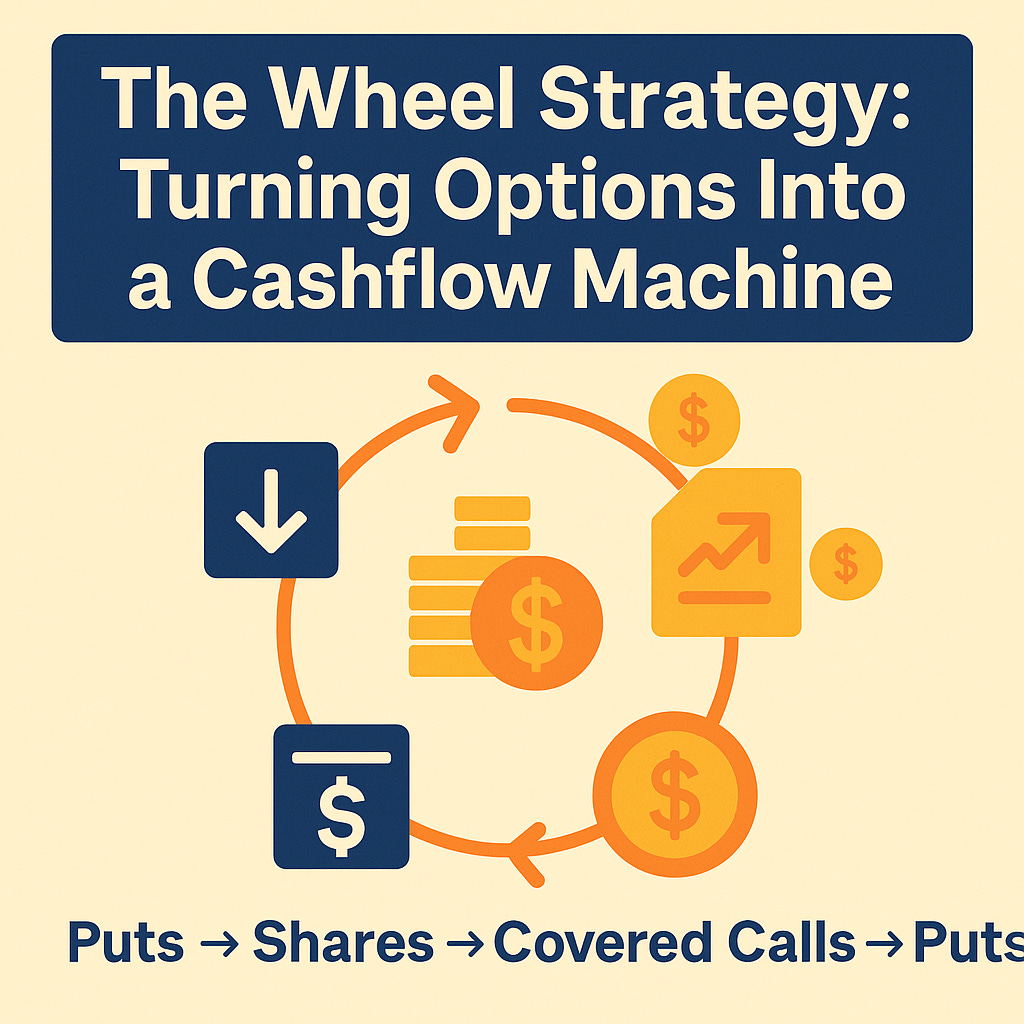
That repeatable cycle is what makes it a cashflow machine.
The idea is simple enough but like most things, the application is more involved than you’d think. In fact, I’d be willing to wager that most who rush off to try this end up having their underlying assets eventually selling off hard and finding themselves stuck underwater in a trade with no income nor equity upside for a potentially long time.
I’ve certainly learned this the hard way when I was starting out.
I’d like to stress the best mindset in using the wheel strategy is to think of it as a yearly or even 6-month campaign.
Here are some details I’ve found very helpful when undertaking a wheel campaign.
Avoiding the Biggest Trap: Dead Money in a Selloff
The danger comes when you buy stock in a selloff and get stuck. The stock is way below your entry, covered calls at your strike are worthless, and you can’t generate income.
My pearls of wisdom:
Start with half your capital. Sell puts Using only half your planned capital.
If assigned, deploy the other half by selling another lot of puts ATM/OTM + an ATM covered call - Turning the trade into a covered strangle. This guarantees that you receive the full premium on either side of the trades as the underlying price obviously cannot simultaneously finish above the call strike and below the put strike at the same time. THIS IS HUGE!
This also allows for lowering the average entry price over time which prevents a situation where I’d otherwise be stuck in a stock too far away from my entry to sell covered calls.
Lastly - whilst ATM puts carry the juiciest premium, if you’re happy to accept lower rates of return you could sell puts further OTM (20 delta, or even 10 if your book is large enough).
Why Dividend Stocks Supercharge the Wheel
Running the Wheel on dividend-paying stocks adds another safety net:
Dividends provide cashflow even in downturns.
Dividend stocks are often more range bound, keeping option premiums steady.
In big drawdowns, dividends help offset the “dead money” risk.
This gives my campaign three cashflow cylinders:
Premiums + Dividends + Capital Gains.
The Wheel in Action – PBR Example
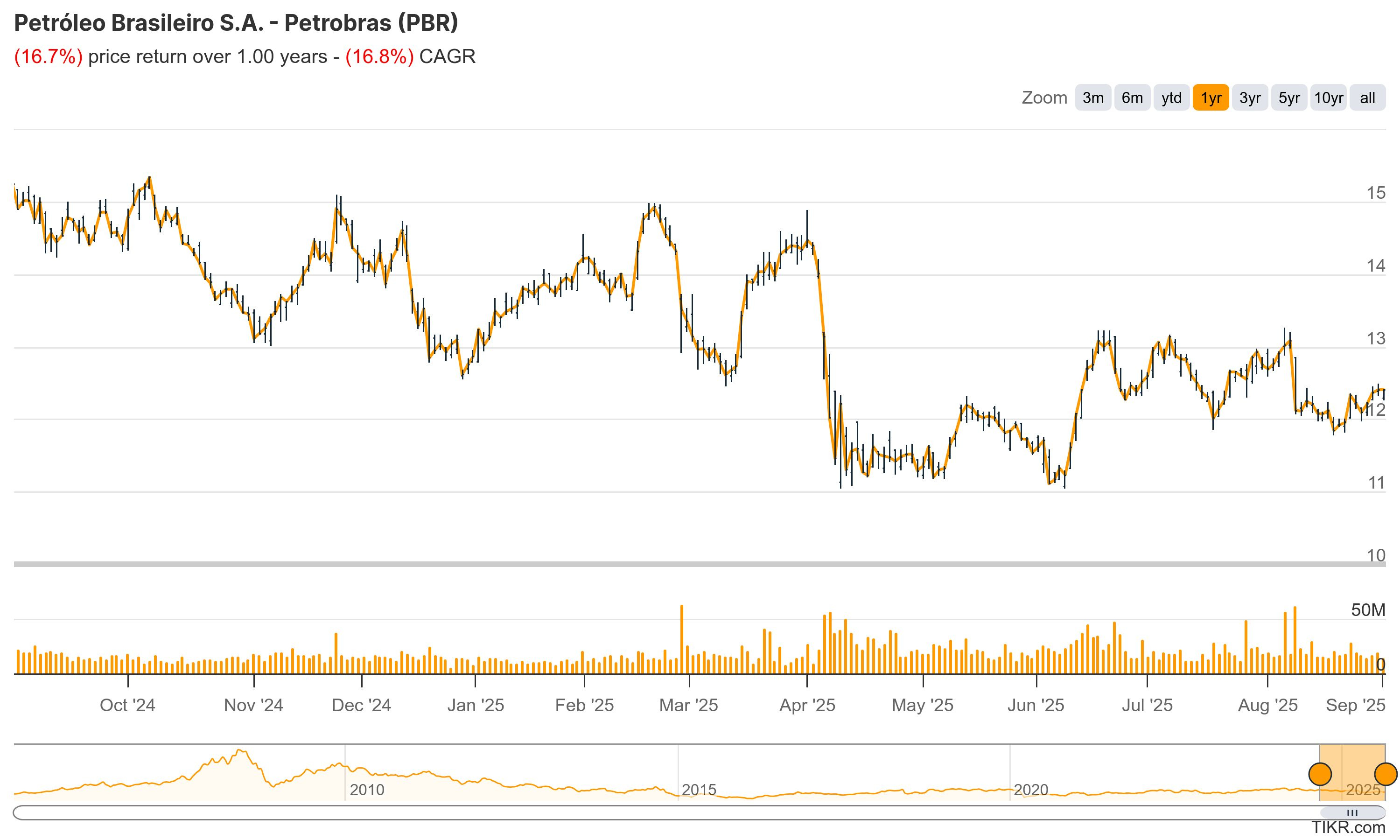
To make this concrete, here’s how I recently applied the Wheel on Petrobras (PBR):
Step 1: Selling Cash-Secured Puts
Stock: PBR - A stock I know well, expecting 10% + divvy
RSI ~35 (oversold), MACD turned positive
Stock price: ~$12.20
Trade: Sell the $12 strike put, 30 DTE
Premium: ~$0.20 per share - $20 per lot (100 shares).
Collateral: $1,200 per lot -
I scale up according to my goals I.e: If I want $200 income from this strategy I sell 10x lots and hence require $12,000. For $2,000 income → $120,000 etc.
Outcomes:
If PBR stays ≥ $12 → keep $0.20 (≈ 1.7% in a month, ~20% annualised).
If assigned → effective cost basis = $11.80.
Step 2: Selling Covered Calls (Assuming Assignment)
Entry price: $12.00 (or $11.80 effective after put premium)
Strike: $12.50 call, 30 DTE
Premium: ~$0.26 (unchanged)
Outcome:
A/ If PBR stays ≤ $12.50→ keep $0.26. Return on Capital ($26/$1,200) ≈ 2.2% in a month. I repeat the process next month.
B/ If PBR moves up ≥ $12.50→ The stock will be called away and I am obliged to sell for $12.50 per share.
Call premium collected = $0.26 per share = $26 per lot
Capital gain = $12.50 – $12.00 = $0.50 per share or $50 per lot
For the all-in profit from start to finish on this round trip adventure using the wheel strategy:
Put premium = $20
Call premium = $26
Capital gain = $50
Total = $96 per lot
Return on Collateral
Collateral required = $1,200 per lot
Return = $96 ÷ $1,200 = 8.0% over ~2 months
Annualised ≈ 48% (if repeated consistently)
Notes:
If I am holding the stock on the ex-dividend dates throughout the year I will receive those dividends - good idea to sell the calls at a higher price around those times to qualify for the dividends but I will sacrifice option premium as they are further OTM.
Asset selection here is important as the tactic isn’t so much about buying and holding for appreciation- I’m after a range bound stock that’s not prone to huge yearly moves so I can keep writing fairly close to the money to juice the yield.
Very different mindset to long term investing - this is a cash generating business where’ I’m trying to recycle as many options contracts + dividends through the same capital outlay as possible. (Analogous to owning a short term rental on airbnb - I want cash generating turnover).
RSI & MACD can help time entries/exits → sell puts when oversold, sell calls when overbought.
Dividend timing is critical → high-yield names often get early assignment near ex-dividend dates. Adjust strikes 5–7% OTM or skip that week to avoid surprises.
En Fin..
The Wheel is simple, but when you add:
Technical timing
Dividend awareness
Tactics like covered strangles
I can use it as a scalable digital income strategy - One cylinder in my options income engine.
In future pieces, I’ll break down strike selection, risk management, and scaling the Wheel across multiple tickers.
Until next time - All the best and due your own due diligence.
Benjamin

Disclaimer: This publication is intended solely for documenting my personal journey with trading and investments for income and travel purposes. I am not a certified financial advisor nor am I a financial professional and none of the content provided should be construed as investment advice. It is essential to conduct your own thorough research and consult a registered financial service provider for appropriate guidance. I cannot guarantee the accuracy or completeness of the information presented. Any actions taken based on the information shared in any of my work are done at your own risk and discretion.
Ready to Take Your ROI to the Next Level?
Upgrade to premium membership and gain exclusive access to:
The ROI Club: Dedicated to the art of Return On Investment
My investment research that has delivered multi-baggers returns.
The Options Income Engine: Generating Location-Independent Income in order to live:
Where you want
When you want
With whom you want
Doing what you want
I’ve always liked this understanding/explanation of selling puts: “I liken it to getting paid to place a limit order.”
What are your current “favorites” to sell puts on? LB, GROY, Mesabi Trust?
THANKS again for the great read
This is extremely helpful as I occasionally dabble with options but not regularly enough to gain the knowledge and fully “get it”.
I imagine my next question would probably get into the deadly realms of financial advice but I’ll ask anyway: Have you considered a bolt on paid service for subscribers which is essentially buy/sell this at x strike at y date and trades are sent out?