

Read The Entropy Trap to discover what physics knows the economics doesn’t.
An Overlooked Inflation Beneficiary: Timberland.
Plus 3 stocks that fit the bill.
A productive timberland asset is a fascinating business model.
The investment thesis is elegantly simple: no matter what the macro-economic environment conditions may be, trees simply keep on growing. Every year, the average forest adds 3–5% more wood. If prices are bad, you leave the trees standing — which results in their growing larger and hence more valuable, thanks to the increase in available wood product. Trees grow on land, which is a hard asset that offers an inbuilt inflation protection. Land is also one of the few truly perpetual assets, meaning it has no terminal value, requires limited maintenance CAPEX and also carries embedded optionality for ever higher use cases. In the case of certain forest land or timberland in particular, such land might increasingly earn money from wind leases, carbon credits and/or development projects. Thus, it’s a hard asset with a natural refresh rate plus a perpetual right tail call option on usage and development, often with a positive carry.
Oh, and I almost forgot, don’t forget what might be underneath the surface like oh, I don’t know…. say mineral rights and royalties?
I’ve been looking for the public companies that offer investment exposure to this theme and can do so with minimal CAPEX.
Three show potential: Weyerhaeuser (WY), Rayonier (RYN) and Acadian Timber ADN).
Right now is an unusual moment in timberland history given that the two larger names sit at 52-week lows and on my numbers all three are priced well below what private buyers pay for comparable acres (about 40% below).
Timber is one of the few real assets you can still buy well below its private-market value in 2026.
A comparative overview and valuation case for each is provided today.
The Humble Forest As A Perpetual Compounder
A mine eventually runs out of economically viable ore. An oilfield’s production inexorably declines. A well-managed forest however does not have to deplete or decline. It’s naturally endowed with four return drivers and only one of them depends on the economy.
Biological growth. Mature pine trees add roughly 3–5% more wood every year, while those at their commercial peak (15-30 years) can even outpace that grow at 5%+ per annum. A juggernaut which marches on whether the Fed is easing or tightening. Trees also move up the value ladder as they grow, from pulpwood to sawtimber, which is worth several times more per ton.
Optionality on the wood. When log prices are bad, you leave the trees standing and they continue growing. As trees get bigger, the wood moves into more valuable grades. EG: Pulp logs sell for about $60/m³, while large sawlogs fetch about $150/m³. Ergo, each cubic metre doubles or triples in value simply by getting older. This is why the owner’s option to wait pays off: a tree you don’t cut this year is both bigger and more valuable per unit next year.
The land. Timberland has historically kept pace with inflation and the best acres graduate to higher-value uses. For instance, Rayonier sold 15,000 rural acres this year at about $6,000 each and development land at about $261,000 an acre. Quite the contrast against the implied $1,270 an acre of its stock price today.
The land’s optionality. Monetisable uses like: Carbon credits, wind and solar leases, minerals sales are just some of the ways that timberland always seems to find new sources of cashflows. Weyerhaeuser already earns over $100M a year from such interests and Acadian says that a single wind lease could eventually dwarf its timber income.
Inflation Hedge With A Positive Carry
The timber aspect of these businesses isn’t closely correlated with inflation, but the underlying land and associated leases usually keep pace, albeit in an asynchronous way.
An extremely interesting hidden lever that these assets have is their fixed debt. Weyerhaeuser’s long-term debt is mostly fixed at about 5.1%. If inflation runs hot, the nominal value of said debt falls, adding a tailwind to the returns. That’s intelligent leverage.
The 3 Musketeers
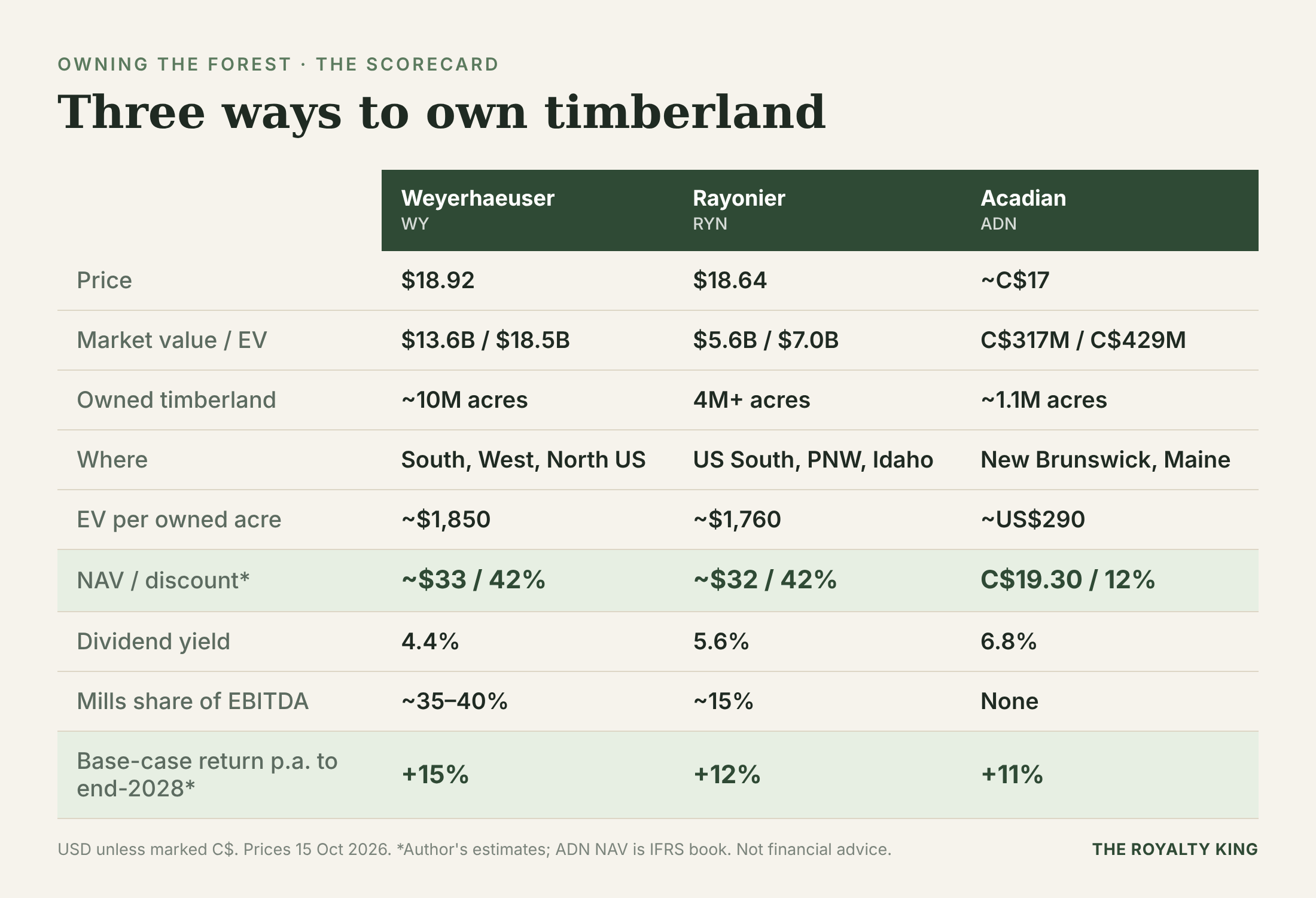
Weyerhaeuser (WY, $18.92): the giant hybrid. About 10 million acres of US timberland, the largest private estate in the country, plus 13 million licensed acres in Canada. It also runs one of the biggest lumber, OSB and engineered-wood businesses in North America, and a growing ‘Strategic Land Solutions’ arm selling development land, minerals, renewables leases and forest carbon. The forest is the asset; the mills are the mood swings.
Rayonier (RYN, $18.64): the clean pure play. Merged with PotlatchDeltic in January 2026, creating 4M+ acres concentrated in the fast-growing US South, plus the Pacific Northwest and Idaho, a modest mill business and a real-estate arm selling rural acres at about $6,000 each. It has the lowest leverage of the two big names and is buying back stock.
Acadian Timber (ADN, about C$17): the small, pure, northern forest. About 1.1M acres of freehold forest in New Brunswick and Maine, no mills, a 6.8% dividend, and options on wind, carbon and housing development. It is controlled 52% by Macer Forest Holdings.
Valuation Considerations
Price / Acre.
A key consideration when forming an opinion as to value is comparing Enterprise Value and its implied pricing of the land held is Vs comparable private sales.
WY: after stripping out the mills ($4B at 5× mid-cycle EBITDA) and the land-sales premium (about $2.5B), the stock values its 10M acres at about $1,200 each. In Q2 it sold 29,000 non-core Oregon acres for $114M, or ~$3,900/acre. Even its weaker acres sell for 3x today’s implied price.
RYN: the same exercise computes to about $1,270 an acre. Its own real-estate arm sold 15,000 rural acres in H1 at ~$6,000 each, and quality southern pine timberland typically trades at about $2,000–3,000.
ADN: comes in at ~US$290 an acre of EV. IFRS book value is about 14% above the share price.
Shareholder Returns
The time value of money problem is real ergo the yield you collect while you wait for asset values to be realised by the market matters.
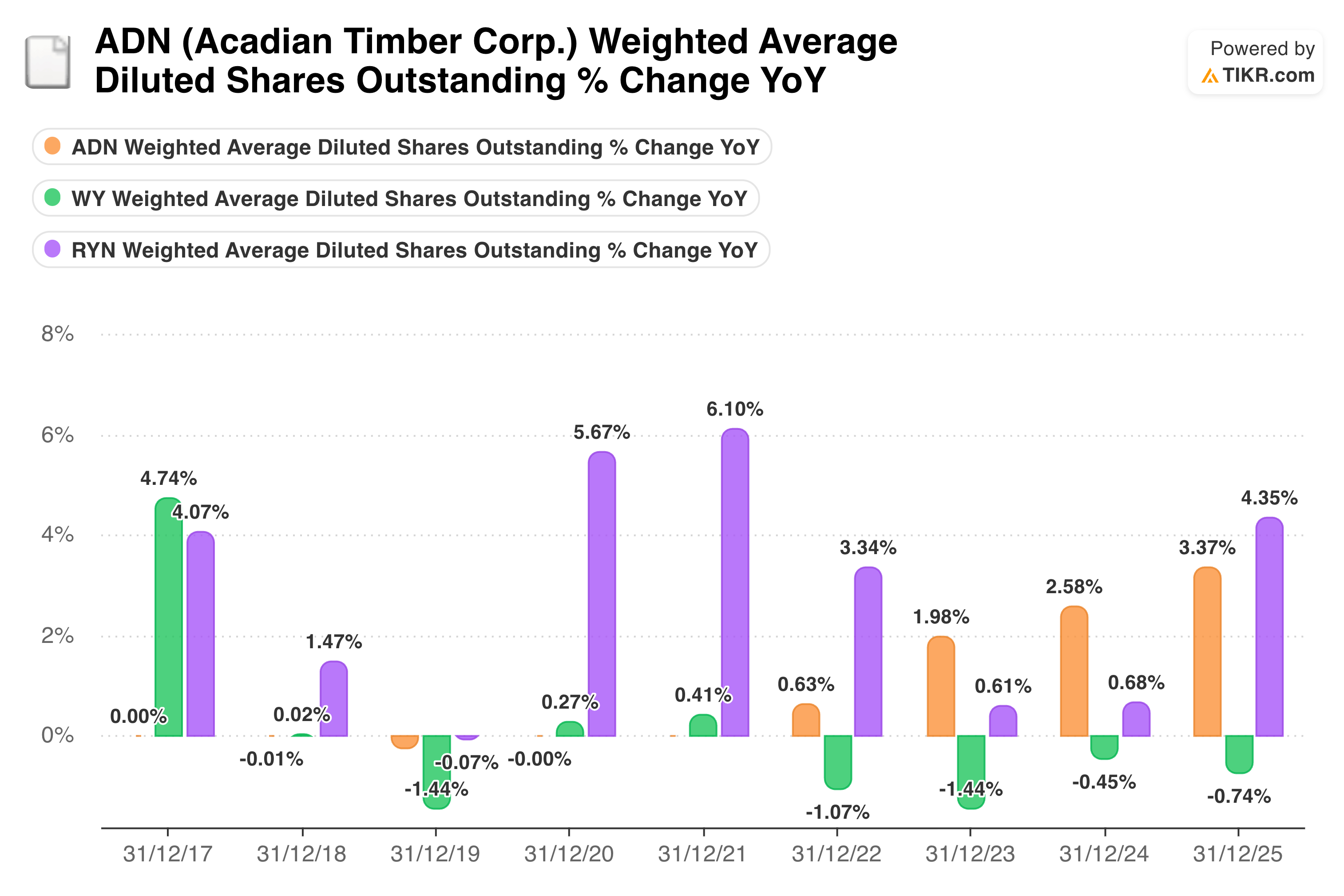
RYN 5.6%: H1 cash available for distribution was $0.59/share for about 5 months of results. Per annum estimated at $1.15 FCF funding a $1.04 dividend. It is also buying back stock which I love to see at these prices.
WY 4.4%: the base dividend of about $610M a year is covered by timberland and land cash flow without the mills. Variable payouts (buybacks or a supplemental) return when wood product cycle bounces.
ADN 6.8%: the highest yield, but H1 free cash flow covered only half of it so that needs to be monitored. It survives because its majority shareholder takes its dividend in shares.
Cyclicality
Whilst a forest can wait out bad prices. A sawmill cannot.
WY carries the most mill exposure, about 35–40% of EBITDA. Each $10/MBF (thousand board feet) on lumber moves EBITDA by about $50M a year. That’s the cost of being a hybrid. It is also the upside: if US housing eventually recovers toward 1.5–1.6M starts, WY has the most torque.
RYN has PotlatchDeltic’s mills (about 1.1 billion board feet), but they are a much smaller share of the whole.
ADN has no mills, but it relies on regional customers whose pulpwood demand has fallen. It is an indirect cyclical.
Optionality
WY: Large optionality book. Strategic Land Solutions guides about $450M of 2026 EBITDA from >1M acres identified for higher-value use i.e. minerals, wind and solar leases, carbon capture and storage, and forest carbon. Climate Solutions alone targets about $250M of EBITDA by 2030, up from $119M in 2025.
RYN: real estate guided at $180–200M of 2026 EBITDA, with master-planned communities (Wildlight in Florida, Chenal Valley in Arkansas) and steady rural sales at $6,000/acre. Being in Florida provides a friendly jursidiction which makes all the difference to dwelling approvals (Just ask TRC in California!)
ADN: small but potentially big relative to its size. Management says a signed renewable-energy lease could eventually produce “10x plus” its timber income if wind projects proceed… I know.. but it might happen…Add carbon credits from H2 2026 and a Maine housing development from 2027 and call options become apparent.
