

In Proud partnership with The Solstice Laboratory — the physics of markets, quantified. Read The Entropy Trap to discover what physics knows the economics doesn’t.
An informal dispatch on markets, money and my musings. For those who want to go deeper, the links are at the bottom.
— Vernazza, Ligurian Coast. Italy. August 23.2026.

Market Musings
The big news this week was of course the first US-Yen intervention since 1998 led by US Secretary of the Treasury, Scott Bessent.
One can’t help but be reminded of the (likely apocryphal) allegory of King Canute, the Viking who once ruled in what was dubbed the ‘North Sea Kingdom’ which covered England and many parts of Scandinavia around 1016-1028. It is alleged the good king Canute had his throne taken to the shore and commanded the waves to stop. However, the laws of nature, being what they are, ignored the command and proceeded to soak his feet anyway.
991 years later, another very powerful man attempts to stem the tide in US bond yields to prevent water seeping into the rest of US asset classes.
The yen this week was near a 40 year low against the greenback which worried not only Tokyo, but also (moreso?) Washington, which lead to the US government buying Japanese yen in order to prevent it falling further (propping up the currency).
However, instead of using dollars to buy the yen, Bessent sold euros from the US’ reserves and used that money to buy yen, thus avoiding weakening demand for the dollar.
Why?
Japan owns more US government debt than any other country. A collapsing yen forces Japan to sell their US Bonds to prop up their own currency. Naturally, the subsequent dumping of US treasuries would result in lower bond prices and thus higher yields and consequentially spike US borrowing costs. (Think of bond yields as the interest rate the US pays to finance its own debt).
There also appears to be a push to expand a lending facility (REPO) so Japan can borrow dollars using its Treasuries as collateral, instead of having to sell them outright (Similar to a line of credit on your house which provides you with liquidity without having to sell your house).
What does this mean?
Essentially this is the official signal that the US is willing to monetise its own debt, albeit initially via a little subterfuge.
It’s early days and IMHO people are getting a little too excited, but this was certainly noticed in the gold market - rising 5.27% in 5 days and now up 14% in the last month alone, while 2.10.20 and 30 year yields all rose significantly alongside it.
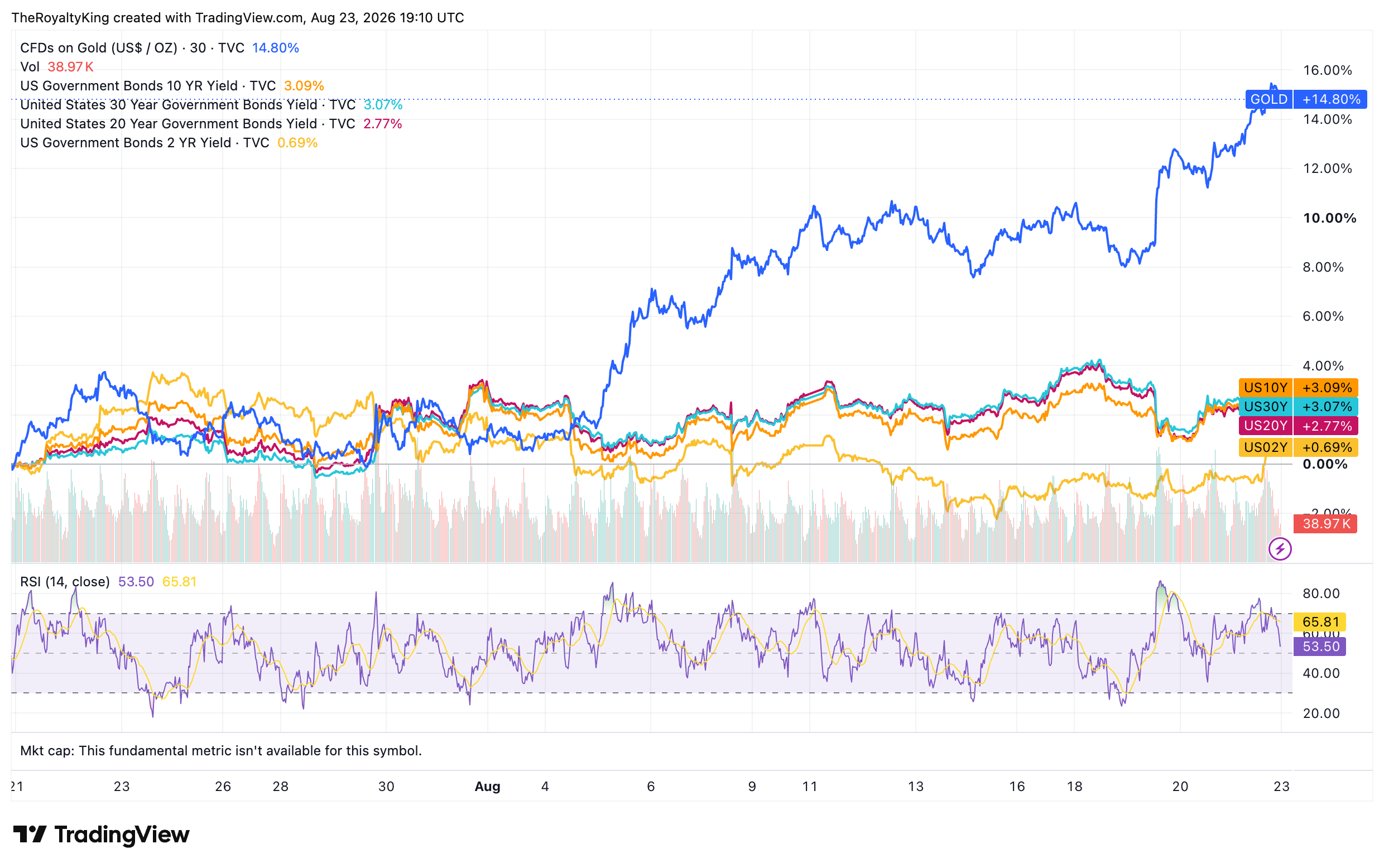
Bond Market Banter
Given the US government finances itself through issuing debt: bills, notes or bonds, it looks to issue at whichever end of the curve has lower yields (cheaper interest rates on its debt).
Given the shorter end of the yield curve has a lower interest rate ~3.63% currently, Vs 5% on the 20 yr, the US is clearly incentivised to do as much of its funding as possible on the shorter end where demand is deep, liquid and could withstand a sell off. However, roughly $5.3 Trillion of treasuries have a duration of more than 10 years with higher rates and are less liquid ergo cannot easily absorb a potential Japanese sell off hence Bessent’s move to prevent this from occurring during the week. This still is merely biding time and fighting against the tide.
The only long term solution is to collateralise the debt using an asset that isn’t simultaneously a liability — Gold.
Section 2.10 of the Fed's Financial Accounting Manual allows the 261 million Oz of gold held in the Treasury General Account (TGA) to be revalued under the direction of the treasury. The gold is currently marked at its 1973 accounting value of $42.22/oz. The question driving my underlying gold thesis is ‘ what price would it need to be to cancel the long term bonds and push US funding over to short duration bills whose rates are more friendly can be massaged through stablecoin demand dynamics?
Answer = $5.3T ÷ 261M oz = ~$20,307/oz increase from $44.22, or
~$20,350/oz. A 4x move.
From another angle, foreign creditors need assurance that the US will be able to honour its obligations in real terms in order to keep holding and rolling their US treasuries (keep financing the US). At today’s spot price, US gold holdings only back approximately 11% of foreign-held treasuries. Historically, foreigners have needed 40-60% backing in order to feel comfortable holding their treasuries and avoid a sell off and subsequent spike in bond yields.
Again, this implies a >4x move from today’s spot price.
Previously, the conservative case for gold at $7,500 was examined, because $20K almost seemed embarrassing to write.

Yet, after this week’s events, the following meme did come to mind..

Therefore, let’s examine my top Royalty holdings through the lens of $20,000 gold.
To access the valuation deck adjusted for $20,000, please become a premium member today for $125/ year, that’s only 34 cents per day!
Sources:
https://discoveryalert.com.au/u-s-gold-revaluation-a-potential-solution-to-the-national-debt-crisis/
https://en.majalla.com/node/328158/business-economy/revaluing-us-gold-reserves-comes-pros-and-cons
https://www.jpost.com/business-and-innovation/precious-metals/article-829152
