

I’ll be attending the Rule Symposium (online) this year.
If you’re serious about commodities, capital cycles, and long-duration thinking — this is where the real conversations happen.
Join us here: https://cvent.me/XOqdLa?via=BenjaminDemase
Two main investment themes have dominated the thinking in this publication for some time now. The first is monetary debasement. The second I loosely call ‘consumer commodities’: the idea that years of underinvestment in supply will eventually collide with surging localised demand, potentially in spectacular fashion.
2025 was a big year for the debasement angle. Gold along with Royalty & Streaming companies featured so heavily that along the way I stopped being the ROI guy and became ‘The Royalty King.’ When your own readership rebrands you, effectively the market has spoken and it seems wise to listen.
2026 turns the page. The consumer commodities thesis moves to the foreground and within it, one asset class above all others demands attention.
Water.
Mirar el río hecho de tiempo y agua y recordar que el tiempo es otro río, saber que nos perdemos como el río y que los rostros pasan como el agua
— Jorge Luis Borges, ‘Arte Poética’ (1960)
(To look at the river made of time and water and remember that time is another river to know that we are lost like the river and that faces dissolve like water.)

Of all the commodities one might consider, only two can genuinely claim to be perpetual in the state in which they’re naturally found: land and water. Gold is timeless yet it requires refining and processing. Oil also is refined before use and undergoes a complete state change once consumed as does every other commodity in practical terms.
Land simply exists. It’s immovable, unreproducible and indifferent to the passage of time.
And water?
Water is even more peculiar. In its usable state, it too is naturally scarce and constrained by geography and infrastructure. It is also consumed and can undergo state changes - like most other commodities. Yet unlike any other commodity, water possesses a natural refresh rate in its state of end-consumption. (Sticklers may point out lumbar has a refresh rate through forests etc. yet a tree requires a phase transition of sorts before being consumed: from seed to tree, which is in turn milled etc.)
Given the right conditions, nature replenishes water. The aquifer refills. The river runs again. It is the only commodity in existence where scarcity and renewal coexist but only when nature’s schedule is allowed to run uninterrupted.
Just as available land per capita shrinks alongside population growth and forces human ingenuity to constantly find higher and higher uses for every acre, the same growth, and the technological appetite that accompanies it, is now bearing down on water with a force that may test the limits of nature’s ability to refresh it. This convergence appears unique in human history. The stakes are not abstract given humans survive only days without water. History has consistently demonstrated, those who provide solutions to civilisation’s most pressing problems tend to be rewarded handsomely for doing so.
This mini-series will focus on exactly those companies — the ones positioned to solve and monetise the coming water constraint in various ways.
Newer readers can get up to speed with the demand pressures of water from ‘AI’ datacentres here:


Today’s company is on the cusp of relieving demand pressure in southern California. And as it happens, it does so through the signature business model that regular readers of this publication will recognise immediately: capital-light, toll both-type economics.
Cadiz Inc. (NASDAQ: CDZI) has existed in various forms since 1983, sitting on 45,000 acres of land in California’s eastern Mojave Desert, above one of the largest undeveloped groundwater aquifers in the American Southwest. Long time shareholders have been decimated by the ‘California risk’ as this genuinely impressive asset has unfortunately been encumbered by regulatory delay, political opposition, and a balance sheet that required a patience that few investors possess.
That patience is now being rewarded.
What Cadiz owns is deceptively simple: land, water, and pipe. Specifically, 2.5 million acre-feet of water supply, 220 miles of pipeline infrastructure threading through the corridors between California’s major water systems, and the rights to extract, store, and deliver water to agricultural and municipal customers across Southern California. The asset is not depleting given the aquifer recharges. The pipeline, once built, will move water for decades. This is precisely the kind of infrastructure that fits the perpetuity framework outlined above — not a mine that exhausts itself, not a well that pressures off, but a system that, once operational, functions more like a toll road than a commodity centric company.
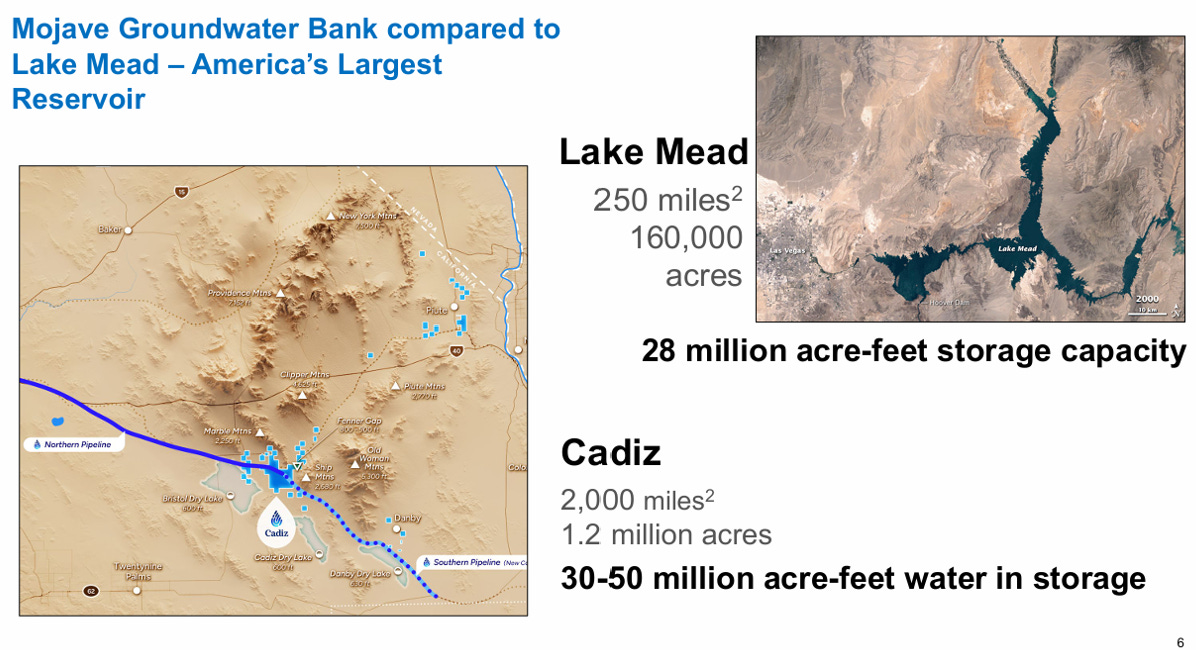
The business model reinforces the analogy. Through the newly formed Mojave Water Infrastructure Company (MWI), Cadiz is bringing in outside capital to finance construction — up to $450 million in total equity — while retaining 49% of water storage rights and all existing water supply purchase contracts. The company monetises the flow. Long term readers will recognise the architecture immediately. The infrastructure carries the water. The aquifer replenishes.
Construction is no longer theoretical. The Northern Pipeline is targeted for completion at end-2026, the Southern Pipeline by end-2027. The first tranche of project financing — $51 million from the Lytton Rancheria of California — has been executed under a definitive agreement. Steel has been secured, repurposed from the cancelled Keystone XL pipeline. The permits are advancing under federal emergency water infrastructure provisions. The pieces are falling into place with a specificity that distinguishes this from the Cadiz of prior years, when the same assets existed but the path to revenue did not.
The market, far from being efficient, appears completely oblivious to an opportunity which, based on management’s own NPV estimate for already contracted cash flows, is 4x the current market capitalisation. Let’s now take a deep dive into the valuation.
